Every time you send a message, stream video or connect a device to Wi-Fi, invisible networks are making decisions in the background — routing information, allocating resources and adapting to changing demands.
Your smartphone decides how to connect, power grids balance demand and supply, autonomous vehicles choose routes, drones share airspace and defense systems protect people.
As the number of connected devices grows, the challenge is no longer simply building networks that connect people and systems, but designing networks that can make decisions quickly, efficiently and with limited information.
Arizona State University researcher Eirini Eleni Tsiropoulou is studying how artificial intelligence, or AI, enabled systems can coordinate, adapt and respond efficiently in uncertain environments.
Tsiropoulou, an associate professor of electrical engineering in the School of Electrical, Computer and Energy Engineering, part of the Ira A. Fulton Schools of Engineering at ASU, is combining game theory, reinforcement learning and network economics to improve the way systems share resources, communicate and make decisions.
“I have always been fascinated by systems that are alive with interaction,” she says. “Systems in which many devices, people and decisions are constantly affecting one another, and the central question remains the same: How do we make complex systems behave intelligently, efficiently and fairly under uncertainty?”
In 2026, Tsiropoulou was recognized as a distinguished lecturer by the Institute of Electrical and Electronics Engineers, or IEEE, Communications Society and named one of the “100 Brilliant and Inspiring Women in 6G.”
Tsiropoulou draws inspiration from the concept that intelligence is not only something that lives inside a machine but can also emerge from coordination across an entire system. Designing that coordination so that networks do not simply function but learn and serve society better provides the foundation of her research.
A platform for intelligent networks
Tsiropoulou’s research drives the work inside the Performance and Resource Optimization in Networks Lab, or PROTON Lab, a research group she established at ASU. The name derives from the ancient Greek word proton, meaning “in the first place,” and reflects the lab’s focus on foundational research in network systems. She and her team are also developing new approaches for AI, advanced wireless systems, resource optimization and resilient infrastructure.
“What drew me to ASU was its scale, ambition and willingness to build the future rather than simply react to it,” she says. “It was the right place to build a lab and is uniquely positioned to support this vision, enabling us to develop what is becoming one of the most powerful academic industrial Internet of Things research infrastructures in the U.S.”
Tsiropoulou has expanded the PROTON Lab into a research platform featuring a 2,000-node wireless testbed, enabling researchers to evaluate how communication networks, autonomous systems and connected infrastructure perform under dynamic, unpredictable conditions.

Using tools such as game theory, reinforcement learning and network economics, researchers in the lab study how AI-enabled systems make decisions when devices compete for limited resources, information is incomplete, or conditions change unexpectedly. The PROTON Testbed helps researchers understand how networks can learn, adapt and coordinate more effectively, whether they are supporting reliable communication, autonomous systems or emergency response technologies.
Although highly technical, the research addresses challenges people encounter every day: keeping communication systems reliable, helping autonomous technologies respond safely and improving how critical infrastructure responds during disruptions.
“These networks will be the nervous system of society and, if designed well, they can unlock extraordinary gains in efficiency, safety and quality of life,” she says. “That is why the work we do matters now.”
As society becomes increasingly reliant on connected infrastructure, Tsiropoulou believes AI-driven systems and networks must move beyond fixed, preprogrammed rules and learn to adapt to changing conditions.
Her research explores challenges ranging from resource allocation in next-generation wireless networks to coordination among autonomous systems, including drones operating in increasingly crowded low-altitude airspace. The work also contributes to emerging 6G communication systems, which she says will integrate communication, sensing and decision-making more closely than ever before.
Training digital architects
Beyond advancing research in intelligent systems, Tsiropoulou sees the PROTON Lab as a training ground for future engineers and researchers.
“Students in our lab do much more than learn technical skills,” she says. “They learn how to think across layers, from algorithms to systems to societal impact.”
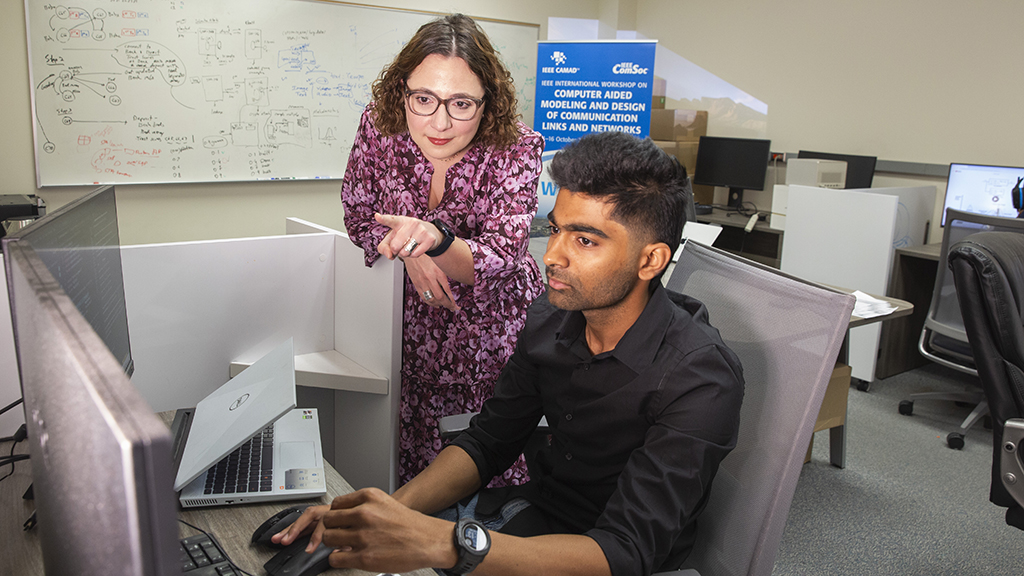
First-year computer engineering doctoral student Dimitrios Kaltsogiannis is conducting research alongside Tsiropoulou to explore how drones can operate and coordinate autonomously in uncertain environments using reinforcement learning and regret learning algorithms.
“The goal is to enable drones to operate, coordinate and localize themselves autonomously, even in highly uncertain environments like those without GPS or any centralized control,” Kaltsogiannis says.
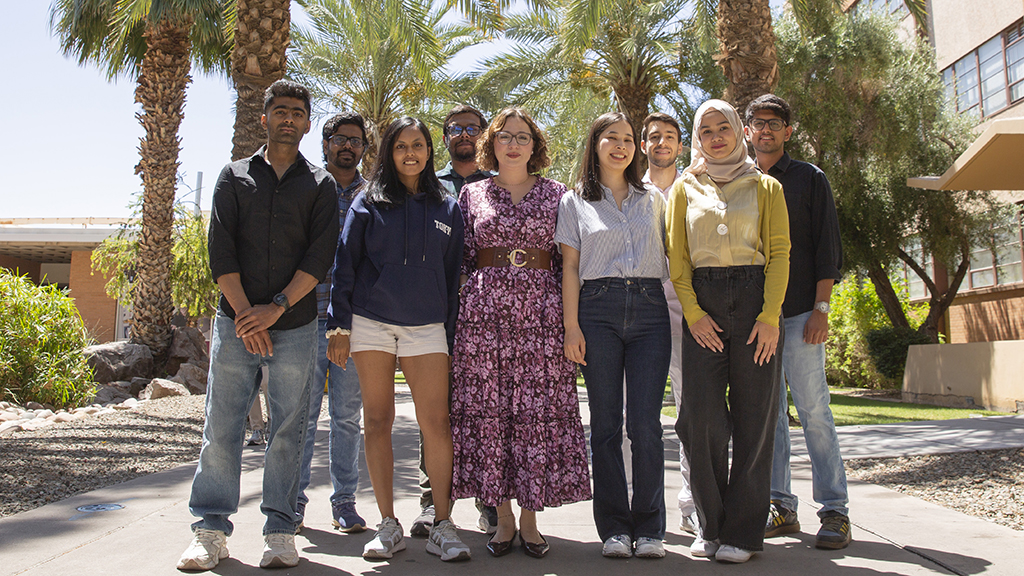
Aruzhan Sabyrbek, another first-year computer engineering doctoral student in the PROTON Lab, studies over-the-air computation technology, a wireless communications concept used in 6G and IoT networks. She says working in the lab and Tsiropoulou’s mentorship has strengthened her technical and professional skills.
“I have learned to efficiently analyze scientific papers, conduct literature reviews identifying research gaps and brainstorm original ideas for scientific papers,” Sabyrbek says. “Besides those hard skills, I improved my communication skills and gained valuable mentorship experience through advising four graduate students on their master’s theses.”
Tsiropoulou believes creating opportunities for students extends beyond the lab. In 2026, she is serving as general chair for multiple major international conferences hosted at ASU, including the IEEE International Symposium on Local and Metropolitan Area Networks, the IEEE International Conference on Network Protocols and the International Conference on Smart Grid and Innovative Frontiers in Telecommunications.
The events will bring leading researchers in networking, communications and intelligent systems to ASU while giving students opportunities to engage directly with experts in the field.
“For students especially, these conferences can be transformative,” she says. “They gain exposure to cutting-edge work, connect with global experts, discover new career pathways and see themselves as part of an international research community.”
Making hidden systems smarter
Over the next decade, Tsiropoulou expects intelligent networks to become more deeply embedded in transportation, industry, health care, homes and critical infrastructure.
As machine-to-machine interaction expands, connected devices will increasingly share resources, prioritize tasks and adapt to changing conditions with less direct human input. To Tsiropoulou, that makes trust, sustainability and fairness central to how these systems are designed.
“When a video call remains stable in a crowded area, when emergency communication gets through during a crisis, when traffic systems become more responsive, intelligent decision-making is operating in the background,” Tsiropoulou says. “My work is about making those hidden systems even better.”