Artificial intelligence is poised to transform how we treat and manage water, one of the world’s most essential resources.
For Arizona State University environmental engineer Tiezheng Tong, that intersection represents one of engineering’s next great challenges and opportunities.
Tong is an associate professor of environmental engineering in the School of Sustainable Engineering and the Built Environment, part of the Ira A. Fulton Schools of Engineering at ASU. He recently received the inaugural Frontiers of Engineering–Engineering Research Visioning Alliance, or FOE-ERVA, Idea Award from the National Academy of Engineering. The award recognizes Frontiers of Engineering alumni whose research visions connect emerging engineering fields with scientific advances.
Tong earned the honor for his proposal tackling engineering systems at the AI-water nexus, which explores how AI can accelerate innovation in water treatment while addressing the growing water demands of AI infrastructure itself.
“AI is becoming a powerful tool for solving engineering problems,” Tong says. “At the same time, it requires significant water resources. We need to think about both sides of that relationship.”
The recognition grew out of Tong’s participation in the 2025 Grainger Foundation Frontiers of Engineering Symposium, where 74 early-career engineers from across the country gathered to discuss emerging research challenges and identify opportunities for collaboration across disciplines.
Those conversations encouraged Tong to broaden his work’s scope beyond developing advanced membrane technologies for desalination and water purification.
“The symposium intentionally brought together people working in completely different areas,” he says. “It pushed me to think beyond my own discipline and consider how AI could transform the entire water sector.”
That broader perspective became the foundation of his award-winning proposal.
Using AI to build smarter water systems
Tong envisions AI supporting every stage of water treatment and reuse, from developing new materials for water treatment and reuse to improving the operation of treatment plants and distribution systems.
Researchers can use AI to rapidly identify new materials for desalination and water purification, reducing the time required to develop next-generation treatment technologies. Once those technologies are deployed, AI can help optimize plant operations, improve energy efficiency, predict equipment performance and enhance contaminant removal.
“AI gives us new tools to understand complex systems,” Tong says. “It can help us discover better materials and operate water treatment processes more efficiently.”
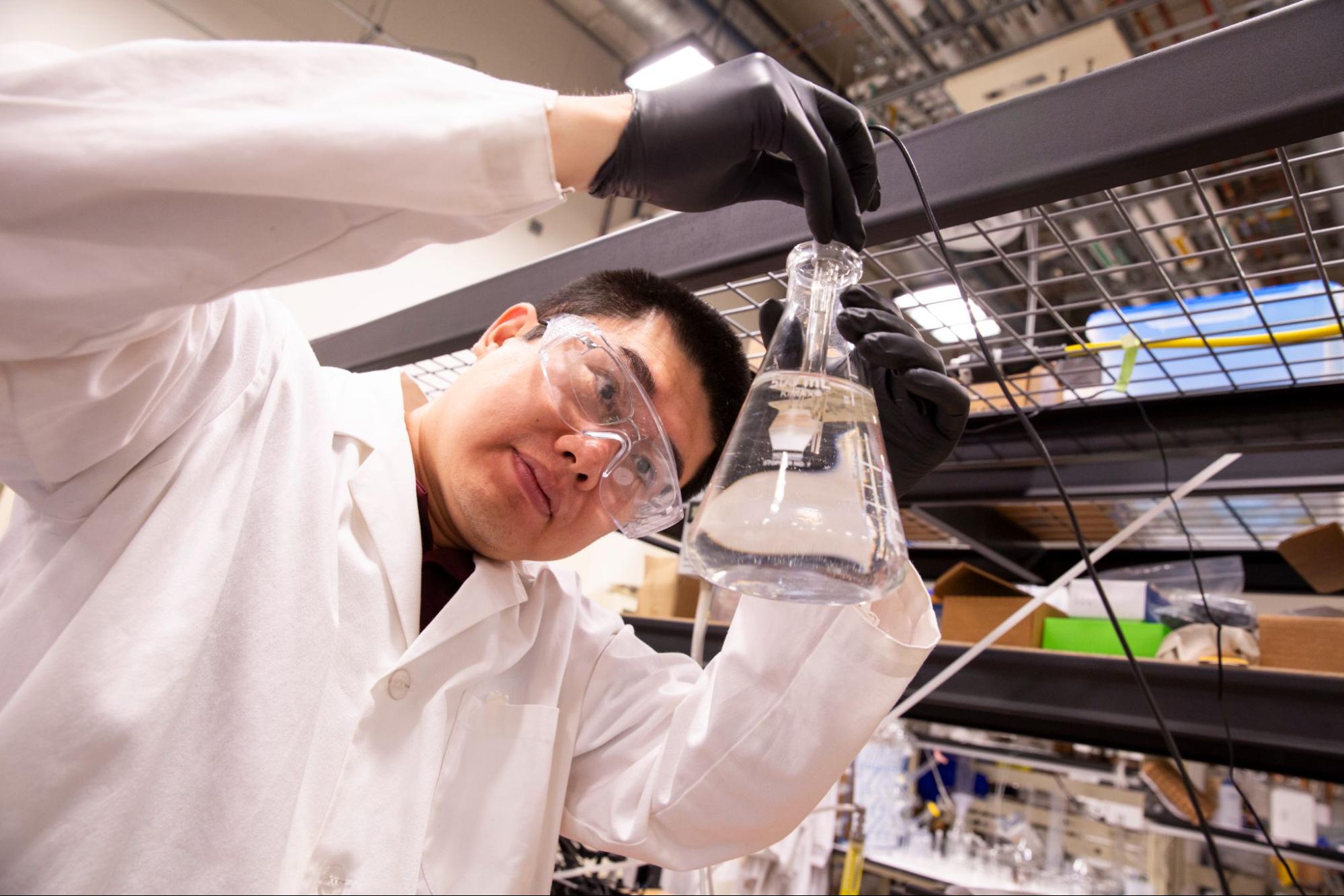
His research group is already applying AI to accelerate membrane development and improve technologies for removing hazardous, synthetic contaminants.
But Tong believes AI’s role extends well beyond laboratory research.
As cities, industries and utilities face increasing pressure to manage limited water resources, AI could help operators make faster, data-driven decisions that improve reliability while reducing costs and water losses.
Addressing the water footprint
While AI offers new opportunities for water sustainability, Tong emphasizes that the technology also creates new challenges.
The rapid expansion of AI depends on water-intensive data centers, which require large volumes of water for cooling. As more facilities are built across the United States, including in Arizona, communities are increasingly examining their impacts on local water supplies.
Tong’s vision for the AI-water nexus addresses that challenge directly. Rather than viewing AI and water as competing priorities, Tong believes engineers should design systems that support both. His lab and collaborators are exploring technologies that would allow data centers to rely more heavily on treated wastewater and recycled cooling water instead of freshwater supplies. Other research efforts include developing new approaches to recover water from unconventional sources.
Arizona offers a living laboratory
The work is particularly relevant in Arizona, where long-term drought, Colorado River shortages and rapid economic growth have intensified the need for innovative water solutions.
The state’s expanding semiconductor industry, growing network of data centers and continued investment in advanced manufacturing all depend on reliable water supplies.
“Arizona is one of the best places to study water reuse and advanced water treatment,” Tong says. “Industries here recognize the importance of water management and are willing to invest in innovative technologies.”
Those challenges — and partnerships with industry — make Arizona an ideal environment for advancing research at the intersection of AI and water.
Since joining ASU in 2024, Tong has continued building an interdisciplinary research program focused on desalination, membrane technologies and sustainable water treatment while expanding collaborations with researchers across engineering and computer science.
Future-forward innovation
Receiving the FOE-ERVA Idea Award validates what Tong sees as a growing shift in engineering research.
As AI becomes integrated into nearly every scientific discipline, he believes the barriers between fields will continue to fall, creating new opportunities for collaboration and discovery.
He hopes the recognition will lead to new partnerships and research initiatives focused on ensuring that AI not only accelerates technological innovation but also advances global water sustainability.
“I tell my students to embrace AI as a research tool,” Tong says. “They need to understand where it works, where it doesn’t and how it can help solve important engineering problems.”
For Tong, the future of AI and water is not about choosing one over the other. It’s about designing engineering systems that allow both to thrive.
“There are many challenges faced by our society,” he says. “If we can develop better solutions for water management, we can also support the sustainable growth of artificial intelligence. Those goals should move forward together.”