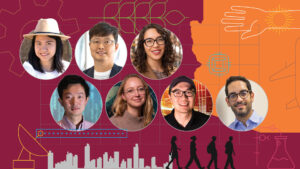
Martin Mwangi Ndegwa did not need to convince Kenyan students that artificial intelligence was interesting. He says the curiosity was already there. Kids talked about AI, robotics and the technologies they glimpsed through phones, games and online searches.
This past summer, Ndegwa, a master’s student in data science, analytics and engineering in the School of Computing and Augmented Intelligence, part of the Ira A. Fulton Schools of Engineering at Arizona State University, returned to home to Kenya with a plan to teach AI and data literacy as part of a community give-back project connected to his Mastercard Foundation scholarship. But once he began visiting schools, the project changed.
Some of the schools he visited lacked reliable electricity. Some did not have computers. Internet access was limited. In parts of Kilifi County, where Ndegwa visited rural primary schools near the Arabuko Sokoke forest, even access to books was a challenge. For some communities, the nearest library services were more than 30 kilometers away.
“You can do your best to plan everything,” Ndegwa says. “But when you go to the field, you have to listen to what the field requires.”

Listening to the field
That sentence became the real thesis of the summer.
Ndegwa’s first idea was straightforward. He wanted to create a curriculum that would introduce students to AI and data literacy. Students were growing up in a world increasingly shaped by AI, yet many had few chances to learn how the technology worked or when to question it.
After taking a data mining course with Hua Wei, a Fulton Schools assistant professor of computer science and engineering, Ndegwa learned about Wei’s Data Mining and Reinforcement Learning Group, which explores how AI systems can help develop educational materials. Wei connected him with members of the group, including computer science doctoral student Huaiyuan Yao and Wanpeng Xu, a doctoral student in the engineering education systems and design program in The Polytechnic School. The team began developing curriculum materials for Kenyan students.
But the field changed the assignment.
Rather than force a digital curriculum into schools that did not have the infrastructure to support it, Ndegwa pivoted. Working with local partners, he helped establish Shomani Reading Clubs in six rural primary schools. The model gives schools rotating access to collections of books and creates weekly opportunities for students to read, discuss and learn with teacher support.

Before the chatbot
The change did not mean abandoning AI education. It meant asking a different question about what AI education could look like without screens.
If children could not reliably access chatbots, computers or the internet, could AI still help build the habits needed to use it thoughtfully? Could the technology be used upstream, to create printed resources that build curiosity, skepticism and evidence-based thinking without requiring students to use digital tools?
The answer became two illustrated, printed storybooks: “Zuri’s Big Questions,” designed for children ages 8 to 11, and “Amani and the Elephant Problem,” for ages 12 to 15. Both were developed with support from the Instructional Agents system and shaped around Kenyan community life, conservation and classroom realities.
In “Zuri’s Big Questions,” a young girl keeps a blue notebook filled with things she wonders about, including weather, goats, tomatoes at the market and noisy radios. A phone assistant appears in the stories, but Zuri never treats it like an oracle. Sometimes it helps. Sometimes it gives a silly answer. Zuri learns to ask clearer questions, count what she sees, compare answers with information from books, teachers, elders and her own observations.
The book for older readers, “Amani and the Elephant Problem,” raises the stakes. Elephants raid family farms near a conservancy boundary, flattening maize and tomato plants. When a teacher asks a phone assistant for solutions, it suggests high metal fences and loud firecrackers. The answer sounds confident. It is also expensive, impractical and potentially unsafe.
So Amani and her classmates do what the project wants real students to learn. They slow down. They map the damage. They gather evidence. They ask farmers, elders and a wildlife ranger. They consider cost, safety, feasibility and local knowledge. Eventually, they present a small beehive-fence pilot at a village baraza, or community meeting.

Learning before logging on
Ndegwa says he hopes students will build critical thinking skills before they begin relying on AI tools. A chatbot may produce an answer quickly, and it may sound polished or confident, but that does not mean the answer fits the facts, the community or the situation in front of them.
“Once you get an answer, the first step is to confirm what you’ve gotten,” Ndegwa says. “Is it really true?”
Wei says the project addresses students who may not have routine access to AI tools, but who will still inherit a world shaped by them.
“Martin’s impactful work shows why AI education cannot be designed only around the technology itself,” Wei says. “AI may create enormous gains in productivity, but education helps determine how widely those gains translate into human opportunity and prosperity. That starts with understanding the needs of learners and their local context. Instructional agents can help us create and adapt educational materials, but the field teaches us what those materials need to become.”
Perhaps the most important part of the work is its humility. It began with AI. It became books, reading clubs and deeper research questions about adaptation.
“This experience made me increasingly interested in the intersection of AI, data science, conservation and community decision-making,” Ndegwa says.
In a hype cycle obsessed with acceleration, the Kenya pilot reminds us to slow down. Listen to teachers. Listen to children. Listen before building. The future of AI education may not begin with a screen lighting up. It may begin with a child opening a book and learning how to ask a better question.