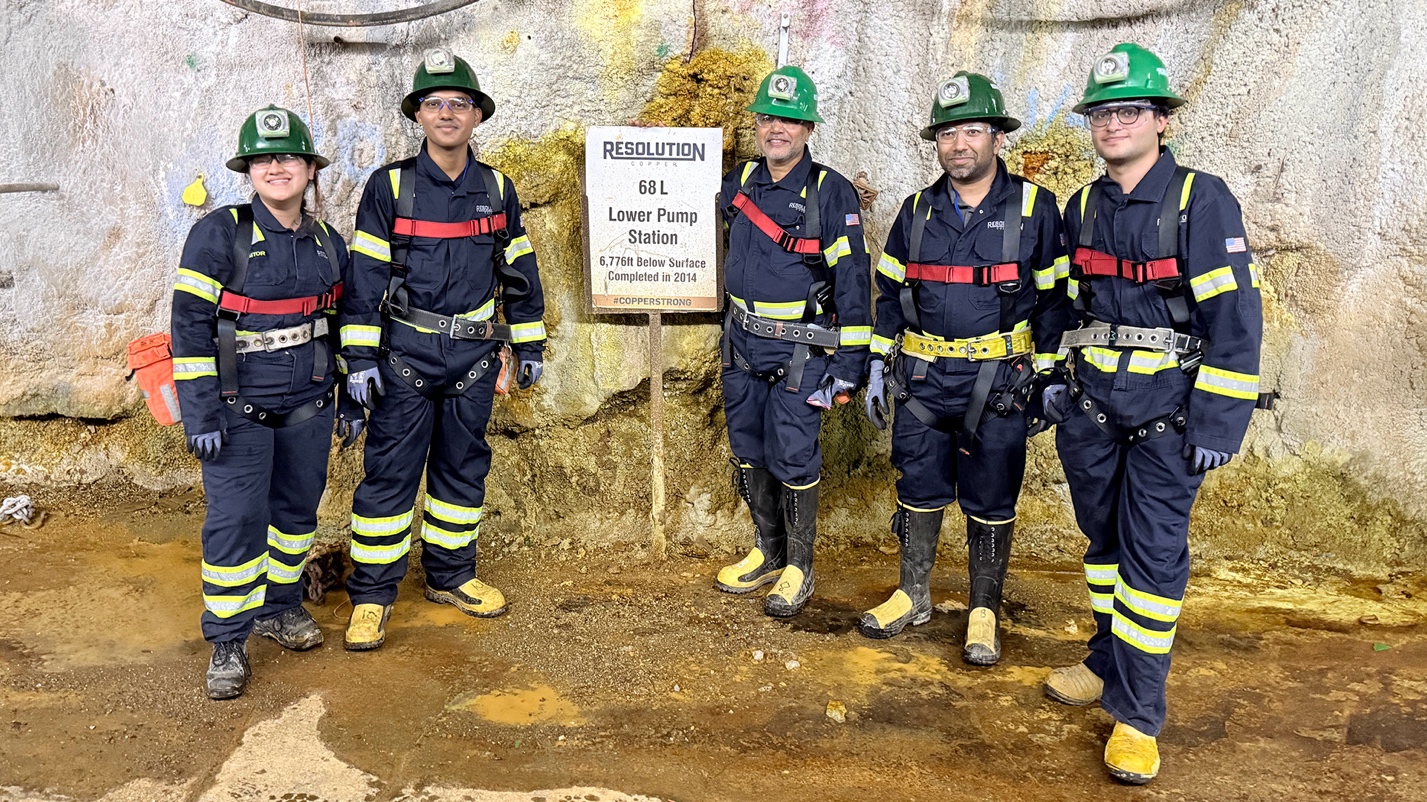
At the bottom of the Resolution Copper mine, the difference between a safe workday and a dangerous one can hinge on water and heat. To keep underground working conditions safe, engineers must anticipate how fast groundwater will flow into the mine and how hot it will become as operations change. But deep underground, those forces are difficult to predict.
That’s where a digital twin comes in.
Near Superior, Arizona, Rio Tinto, a top global mining group, is developing what could become the largest underground copper mine in North America. The project is critical to strengthening the U.S. copper supply, especially as demand surges for use in electric vehicles, renewable energy and the power grid infrastructure. It is also one of the deepest, hottest and most technically complex mining operations ever attempted in the region. Planning for a mine that may operate for decades demands tools that can predict how underground systems will behave long before problems arise.
To help meet that challenge, three graduate students from the School of Computing and Augmented Intelligence, part of the Ira A. Fulton Schools of Engineering at Arizona State University, are bringing computer science underground. Working alongside engineers and researchers at Resolution Copper, they are building a digital twin of the mine, which is a virtual replica that blends physics, data and visualization to forecast how water, heat and operations interact over time.
What is a digital twin?
Sandeep Gupta, a Fulton Schools professor of computer science and engineering, leads the Intelligent Mobile & Pervasive Applications & Communication Technologies Lab, or IMPACT Lab, and is guiding the students through the process of creating a digital twin of the mine. A digital twin is more than a 3D model or a dashboard of sensor readings. It is a dynamic computational representation of a physical system that updates as conditions change. By combining real-world data with physics-based simulations and machine learning, a digital twin can test scenarios and anticipate risks before problems play out in reality.
At Resolution Copper, research focuses on hydrothermal behavior. Engineers are watching how groundwater flows into the mine, how pumping alters those flows and how heat is transferred through rock and water. Because the mine is still under development, it has only a few years of historical data — far less than artificial intelligence, or AI, models typically require.
Ayan Banerjee, a Fulton Schools research associate professor, says that this constraint shaped the students’ work from the start.
“Two or three years of data is not much for machine learning,” Banerjee says. “It limits the model’s ability to generalize, which is why we can’t rely on data alone and have to bring in physics and domain knowledge.”

Making the invisible visible
For Saurabh Dingwani, a master’s student in computer science, the challenge was not just modeling the mine but making it understandable.
Underground mines generate enormous amounts of data, collecting information on geological layers, water tables and pumping systems, but much of it is difficult to interpret outside of specialized software. Dingwani set out to change that by creating interactive, web-based 3D models of the mine.
The models allow users to explore subsurface structures in a browser, visualizing how pumping systems move water and how conditions shift when operations change. Operators can simulate “what if” scenarios, adjusting pumping rates, testing different dewatering strategies or examining how water levels respond over time.
“The web-based models were intended to make it easier to visualize operations,” Dingwani says. “They enable operators to see and simulate what happens if conditions change in the mine.”
By turning abstract data into an interactive environment, Dingwani’s work helps bridge the gap between engineering analysis and real-world decision-making.
Forecasting the future with limited data
While Dingwani focused on visualization, Kuntal Thakur tackled the problem of prediction.
A master’s student in data science, Thakur worked on forecasting how water flow and temperature change as mine operations evolve. Using two to three years of available data, he built statistical models to estimate how groundwater responds to pumping, cooling and shifts in the water table.
“When operators perform operations in the mine, the water flow changes,” Thakur says. “The volume of water changes due to differences in heat, cooling and the water table.”
But limited data quickly became a constraint.
“Statistical models only work when you have a lot of data,” he says.
Thakur’s work clarified the limits of purely data-driven approaches and helped guide the broader project toward hybrid methods that incorporate physical understanding. The experience was also deeply rewarding.
“When I visited the mine, I found it really motivating,” Thakur says. “We’re creating something that will solve real problems.”
Learning the physics
Those real-world constraints were central to the work of Farhat Shaikh, a master’s student in data science focused on water temperature prediction and long-term sustainability.
Shaikh worked on physics-informed digital twins, developing models that embed known physical laws, such as heat transfer and fluid flow, directly into a machine learning system. This approach allows the digital twin to estimate critical parameters even when data is sparse.
“They were trying to use data to predict water temperature, allowing the mine to be more sustainable over time,” Shaikh says. “But the mine had only one to two years of data, which was not enough to effectively train an AI model.”
By combining physics-based equations with sensor data, the models can infer hidden variables, such as thermal diffusion and flow behavior, while staying aligned with real-world conditions.
“It’s our duty to understand the real problem; not just apply a model but understand what’s actually happening in the system,” Shaikh says.
From student research to industry impact
Together, the students’ projects form an integrated digital twin framework that links forecasting, physics-based modeling, and 3D visualization. The system helps mine operators anticipate peak inflows and heat loads, optimize pumping and cooling strategies, and reduce operational risk while working with existing sensors.
Funded by in part by Rio Tinto, the project reflects a growing need for advanced computational tools as mining operations become deeper and more complex.
Gupta says that the work also serves as a training ground for students applying advanced research to real industrial challenges.
“This project shows what’s possible when we combine physics, data and visualization,” Gupta says. “Digital twins let us move beyond reacting to problems and start anticipating them, helping operators make safer, smarter decisions while preparing students to work on systems that truly matter.”


