
2024: Year in Review
Engineering with purpose
In 2024, the faculty, staff and students in the Ira A. Fulton Schools of Engineering at Arizona State University took the initiative to innovate with intention.
The Fulton Schools addressed key issues through research initiatives in data, education, energy, health, security, semiconductor manufacturing and sustainability to generate positive impact. Its awards, achievements and actions are a testament to the values the Fulton Schools strives to embody and impart within the ASU community and beyond.
Revisit some of the year’s most popular stories published in the ASU engineering news blog. The following articles reflect a fraction of the ingenuity and work produced by the Fulton Schools throughout 2024 and serve as a foundation for immeasurable future benefits to the world.
Innovative approaches and tools to help better process, use, manage and access data.
In 2024, the Fulton Schools spearheaded key innovations in artificial intelligence and machine learning to enable smarter, more connected solutions for a sustainable future across various industries.

Kachow! ASU engineers will bring us talking cars
ASU professor Aviral Shrivastava has a plan that allows self-driving cars to collect data through sensors and cameras and tell other vehicles what they detect.

New AI for a new era of discovery
ASU computer science and engineering researcher Kookjin Lee received an NSF CAREER award to develop a machine learning system to discover new scientific laws.

Using AI can improve health outcomes for women
Team of ASU researchers receive multiple grants to develop tech tools to improve treatment options for women.

From ASU to Artemis: Engineering student helps astronauts suit up for moon mission
ASU chemical engineering major Abril Ramos has been instrumental to startup Swift Coat’s success in the NASA Small Business Innovation Research program.

No one left behind: AI-enabled support for aging vets
Four perspectives. Four campuses. Four schools. Four researchers use AI to helping aging vets.

AI to connect small and medium manufacturing companies with a larger clientele
Associate Professor Farhad Ameri is working on a project called the Prototype Open Knowledge Network, or Proto-OKN, an interconnected set of data repositories and knowledge graphs to enable data-driven, AI-based manufacturing solutions.

Discovering new materials using AI and machine learning
An ASU-led collaboration is using AI and machine learning to address critical material shortages and revolutionize materials discovery and manufacturing processes.
Advancing ways to educate engineering students.
Faculty within ASU Engineering focus on learning methods, cognitive theory and best teaching practices to educate the community about the impact engineering has on everyday life. The Fulton Schools are prioritizing collaboration with industry, diverse and inclusive learning environments, and practical, technology-driven education to equip students for leadership roles in the rapidly evolving engineering landscape.

Teamwork among students and robots wins international competition
Desert WAVE, an all-female robotics team, wins international RoboSub competition using two robots in tandem.

Microtechnology advances promising career possibilities
A hands-on workshop with industry leaders gave students a look at work and creative opportunities in the evolving microelectronics field.

Advancing inclusive excellence in engineering
The ASU engineering community has been highly involved in increasing inclusive excellence through education, student success, research and outreach activities.

Expanding engineering education across the career spectrum
The newest of the Ira A. Fulton Schools of Engineering will focus on preparing students to integrate evolving engineering knowledge and expertise into varied industries and professions

ASU students to learn industry skills firsthand in a new entrepreneurship course
(THUMB) A course launching in fall 2024 will provide an opportunity for students to work directly with experts to determine new ways to overcome industry challenges.

Building a modern construction workforce
ASU’s Del E. Webb School of Construction prepares the next generation of construction leaders using modern technology and hands-on experience.

A legend in the baking: ASU alumnus finds success with capstone project
ASU alumnus Tyler Jiemback’s capstone project robot comes to life at Lallemand Baking, enhancing the functionality and automation of the baking process.
Conducting multifaceted research in renewable and alternative energy sources.
The Fulton Schools are at the forefront of innovative energy materials research and next-generation power systems, with a dual emphasis on efficiency and sustainability. Their work integrates academic rigor with industry collaboration to drive advancements in renewable energy, power electronics and materials science for diverse applications, including extreme environments and global energy infrastructure.

Taking batteries B-LO Zero
ASU researcher Nick Rolston is collaborating with Swiss researchers to develop solid-state batteries that can survive extreme temperatures in space.

A bright idea
ASU’s Mojdeh Khorsand Hedman received a 2024 NSF CAREER award to determine how best to integrate distributed electricity resources into the power grid.

Improving electrical efficiency
ASU researcher Wonmo Kang earned an NSF CAREER award to develop a manufacturing technique for materials with ultrahigh electrical conductivity properties.

Charging up an electrified future
Assistant Professor Houqiang Fu received a 2024 NSF CAREER award to improve the efficiency and reliability of power electronics using aluminum nitride.

Perfecting semiconductors for power electronics
Nidhin Kurian Kalarickal collaborated with Agnitron Technology to develop a damage-free etching method for gallium oxide, a semiconductor material.

Setting new standards for materials testing
ASU researcher Nick Rolston received an NSF CAREER Award to advance perovskite solar technology and further develop the field’s workforce.
Discovering future solutions in health research through interdisciplinary collaboration to address critical health challenges.

ASU, Mayo Clinic forge a new health innovation program
Arizona State University is on a mission to drive innovations that will help people lead healthier lives and empower health care professionals to develop novel new health solutions. As part of that goal, the School of Biological and Health Systems Engineering, part of the Ira A. Fulton Schools of Engineering at ASU — with support from the Flinn Foundation — is announcing the Mayo Clinic and Arizona State University Alliance for Health Care Biomedical Engineering Program.
The program aims to enhance education and training opportunities for ASU and Mayo Clinic students, advancing pathways for medical entrepreneurship, clinical immersion and community embeddedness.
Researchers are leveraging artificial intelligence and advanced engineering for medical diagnostics and assistive technologies to improve the quality of life for aging populations and explore novel manufacturing techniques for biomedical applications. Partnerships, such as the ASU-Mayo Clinic collaboration, underscore a commitment to driving medical entrepreneurship and enhancing patient care across sectors.

Harnessing the benefits of stem cells for heart regeneration
Nikkhah and Zhu are exploring stem cell transplantation to repair and possibly regenerate damaged myocardium, or heart tissue.

Advancing technology for a population advancing in years
ASU researchers are using artificial intelligence to improve Alzheimer’s disease treatment, non-invasive health monitoring and independence for older adults.

Using AI to help people see more clearly
ASU researchers use artificial intelligence to improve treatment outcomes for those suffering from the world’s leading cause of vision loss.

Perfecting the pulse of haptics
Hasti Seifi, an assistant professor of computer science, has been awarded the 2024 Faculty Early Career Development (CAREER) Award from the National Science Foundation for her work in making touch technologies more accessible.
Addressing issues of national defense, homeland security and cybersecurity to devise solutions
Researchers are tackling the critical need for cybersecurity innovation to address emerging challenges in a data-driven and connected world. From protecting privacy to the use of artificial intelligence in data systems, the Fulton Schools is preparing the next generation of cybersecurity professionals.
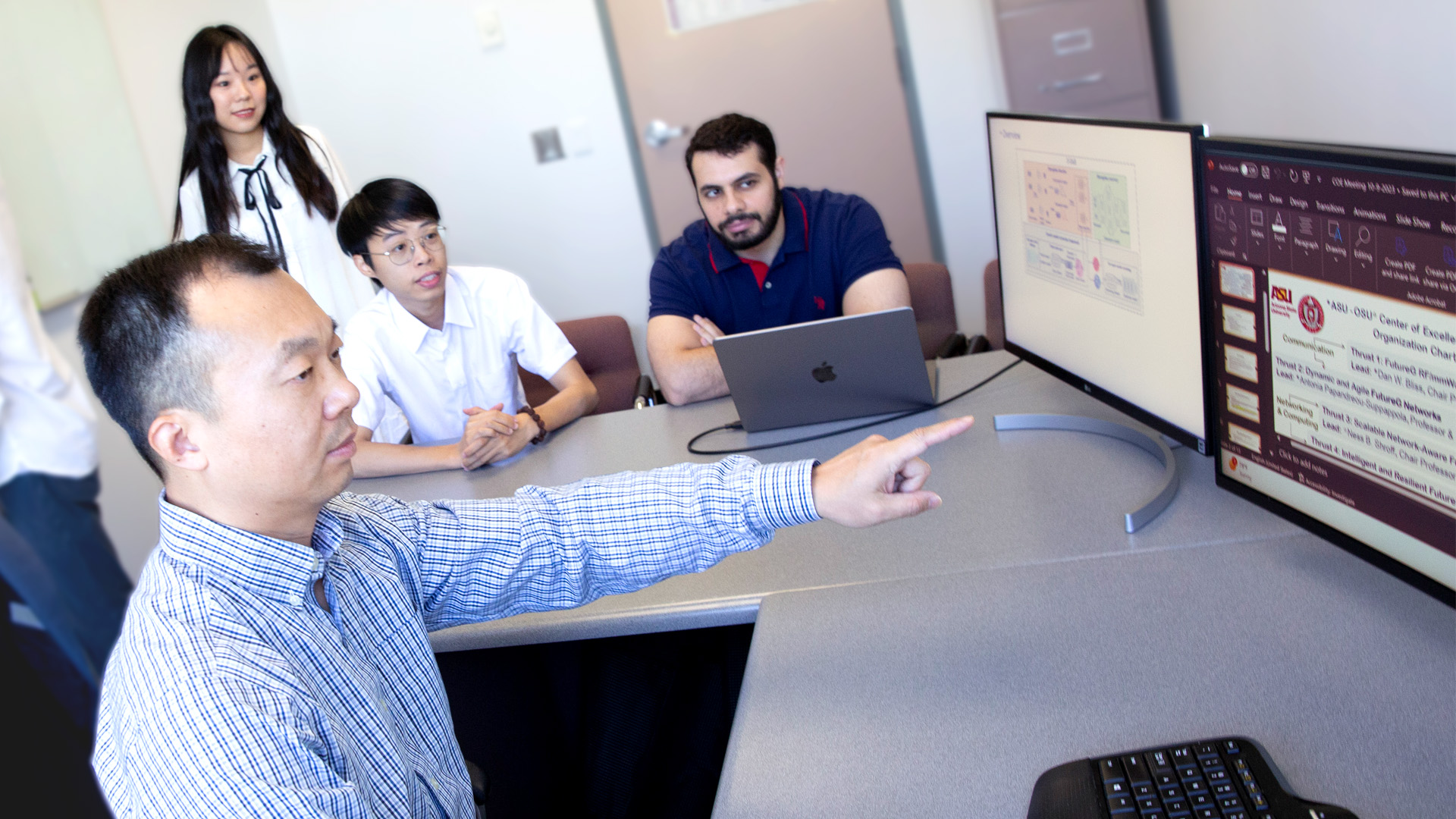
Securing the wireless spectrum
ASU researcher Yanchao Zhang is leading work to ensure the security and privacy of wireless network customers as the user base grows and technology evolves.

Protecting privacy in the age of data proliferation
ASU researcher Oliver Kosut is leading an investigation of methods to protect personal information in aggregate datasets used to train AI algorithms.

ASU receives three DEPSCoR awards for research critical to national security
Teams in ASU’s School of Computing and Augmented Intelligence will conduct research relevant to U.S. Department of Defense science and technology missions.

ASU team creates fast tools to secure cyberphysical systems
Cyberphysical systems, like satellites and drones, are everywhere. ASU faculty members are working to secure them — quickly.

Seeking the biometric bill of rights
Fulton Schools researcher Katina Michael studies the intersection of biotechnology and cybersecurity.

The next generation of cybersecurity pros drills in the dojo
An ASU associate professor has developed the definitive global platform for training a well-qualified, dedicated cybersecurity workforce to fight surging cybercrime.
Discovering more sustainable, reliable and advanced methods for semiconductor manufacturing
ASU is leading a robust effort to strengthen the semiconductor manufacturing supply chain through workforce development, international collaborations and advanced research. Collaborative and global initiatives demonstrate a commitment to fostering talent and innovation in the microelectronics sector.
Strengthening semiconductor skills at the SWAP Hub
The ASU-led SWAP Hub, a U.S. Department of Defense Microelectronics Commons Hub, advances electronic technology and workforce development for national defense.

Cross-border semiconductor collaborations translate success
A technical language course and other workforce development efforts by ASU are set to economically benefit people and businesses in the U.S. and Mexico.

Scaling down manufacturing dimensions to scale up chip production
ASU researcher Chao Wang developed an accessible manufacturing method for researchers to prototype and produce ultrathin nanophotonic devices.

Diagnosing data corruption
ASU researcher awarded by the Open Compute Project to improve microchip quality assessments.

A new dawn in hydrogen purification
ASU doctoral student Daniel Rivera’s innovative research uses electric fields to purify hydrogen in petroleum refineries and semiconductor manufacturing.

ASU startup Crystal Sonic wins Natcast pitch competition
Researcher Mariana Bertoni and team are using acoustics to advance next-generation technology transforming the semiconductor production landscape.

Student research supports semiconductor sustainability
TSMC-sponsored student research projects through FURI aim to improve semiconductor sustainability in use and manufacturing practices
Committing to scalable, interdisciplinary engineering initiatives to ensure a sustainable future
The Fulton Schools is creating a culture and community that commits to sustainable solutions across all disciplines. ASU faculty members and students are using engineering and technology innovations to address global environmental challenges. From reducing carbon emissions to resource management, researchers are exploring alternative opportunities to achieve scalable eco-friendly solutions.

Engineering low-carbon building materials
The new Center for Carbon Efficient and Advanced Manufacturing of Materials and Structures, or CAMMS, directed by Fulton Professor of Structural Materials Narayanan Neithalath, aims to decarbonize the manufacturing of cement, which is responsible for more than 20% of all industrial carbon emissions.
The CAMMS research team plans to use new source materials and improved manufacturing and construction processes to accomplish its goal.

How can cities go green to beat the heat?
ASU researchers pioneered first-of-its-kind research to understand how green spaces and irrigation can reduce the urban heat island effect and carbon emissions.

Engineering equitable solutions for the food-water-energy nexus
Sergi Garcia-Segura is making waves in water accessibility through novel interdisciplinary approaches.

Emerging machine learning expert leads Kenya AI workshop
Gedeon Muhawenayo is on the front lines of AI research, helping tackle the planet’s most pressing problems.

ASU researchers develop new tech to help mitigate carbon emissions
Mani Modayil Korah and Matthew Green earn U.S. Department of Energy support to help curb climate change with innovative carbon capture technology.