At the end of each semester, graduating seniors from the School of Electrical, Computer and Energy Engineering, part of the Ira A. Fulton Schools of Engineering at Arizona State University, form student teams to design, build and refine working systems, resulting in projects that reflect both technical depth and practical impact.
These efforts come together at the school’s Senior Design Capstone Demo Day, where teams showcase solutions shaped by collaboration, creativity and hands-on engineering experience.
James McDonald, a professor of practice and instructor for the senior design capstone course, underscores the impact the project has on students, providing an opportunity to apply four years of engineering education to practical challenges over the course of their final two semesters.
“In addition to engineering knowledge, this course requires students to examine other aspects of projects like scheduling, budget, teamwork and communications,” McDonald says. “This experience truly provides students with a glimpse into their future careers as practicing engineers.”
Among this spring’s projects, one team is developing a sensing system for scientists to study plant activity in the Amazon rainforest, while another is building a wearable device to streamline how live sports are tracked and managed.
Each project serves as an example of how capstone students translate ideas into functional technology with real-world applications as they prepare to embark on their careers.
Leaf it to electrical engineers
Jordan Dunn, Ethan Greenfield, Dustin Nguyen, Andrew Rubio and Luke Williams make up Team Leaf Bizkit, a group taking its classroom knowledge into the field — and ultimately into the Amazon rainforest.
The team focused on building a sensing system that captures subtle biological signals of plant life.
Their project centers on a compact chamber designed to measure plant respiration outputs, including carbon dioxide, humidity, temperature, volatile organic compounds and photosynthetically active radiation.
“The project required iterative engineering design principles so we could ensure every individual component operated on its own before connecting them to work in unison,” Williams says. “We spent a considerable amount of time researching our mentor’s requirements for this device so we could deliver something easy to deploy in the field and that yields the desired data.”
The team’s capstone project originated from a direct research need. Working under the interdisciplinary mentorship of Josh Hihath, a professor in the School of Electrical, Computer and Energy Engineering and center director of the ASU Biodesign Institute Center for Bioelectronics and Biosensors, and Hinsby Cadillo-Quiroz, a professor in the School of Life Sciences.
“Dr. Cadillo-Quiroz leads microbial and ecological research in the Amazon and required a way to collect environmental data at the level of a single leaf,” Greenfield says.
The students’ capstone project is part of a collaboration with a project titled “Biomapping of Tree-based Atmospheric Methane Removal, or TAMR, for Technological Development,” which is sponsored by Homeworld Collective’s Garden Grants: Greenhouse Gas Removal and Spark Climate Solutions.
“These organizations provide financial and organizational support for the development of environmental solutions, derisking new technologies and supporting the goal of reducing greenhouse gases globally,” Cadillo-Quiroz says. “This project and organization will be the platform for disseminating and using the output of the capstone.”
In response, the team worked closely with their mentors.
“We worked closely to ensure the design aligns with the real research needs while remaining adaptable as those needs evolve,” Rubio says. “Regular communication and feedback helped the team refine both functionality and usability of the final device.”
They responded by integrating multiple sensors into a single electronics array while reducing barriers for researchers in the field. This led to designing a system capable of transmitting data via radio communication and operating without an external power supply.
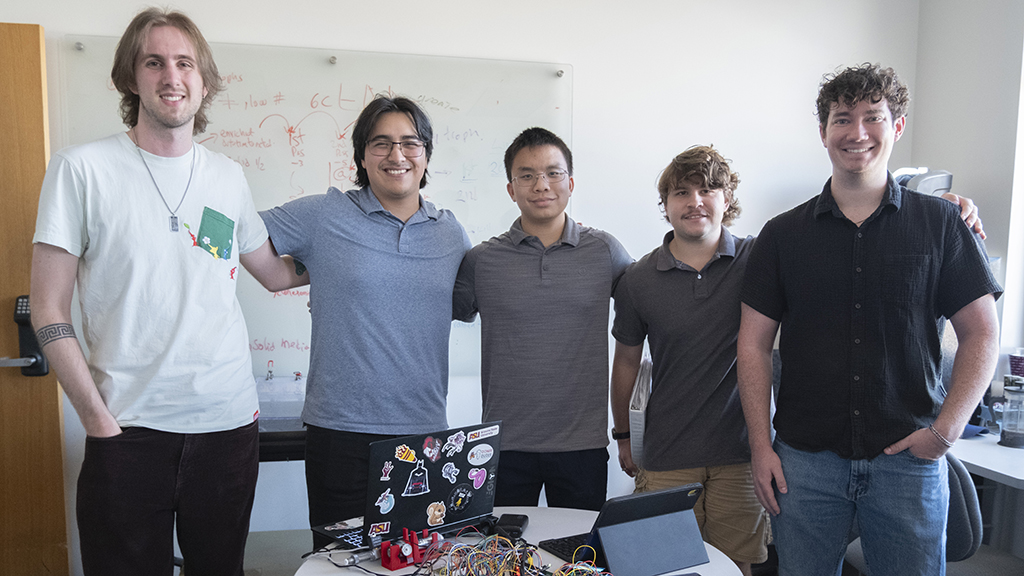
Their work brings together core electrical engineering principles, including circuit design, signal processing, power systems and programming into a single field-ready system.
While the project is part of a culminating course required to graduate, the intended impact extends far beyond the lab.
“The system will support methane emissions research in the Amazon rainforest, which accounts for roughly 8% of global methane output,” Dunn says. “Methane release in plants occurs slowly, so our device must collect precise data continuously for up to 24 hours. By enabling more accurate measurements, our work contributes to broader efforts to understand and reduce greenhouse gas emissions.”
As they prepare to graduate this spring, Team Leaf Bizkit’s device will help researchers capture data that has traditionally been difficult to measure in the field, extending the impact of their work far beyond campus.
Aim to change the game
Nick Dionisio, Mason Lipp, Toller Phipps and Diego Quintero, also seniors graduating this spring, had a project in mind even before the start of their senior year. The four electrical engineering students formed Team MinuteZero and set out to build something of their own.
That idea became ScoreWatch, a wearable scoreboard and game management system designed to simplify how live games are tracked and managed.
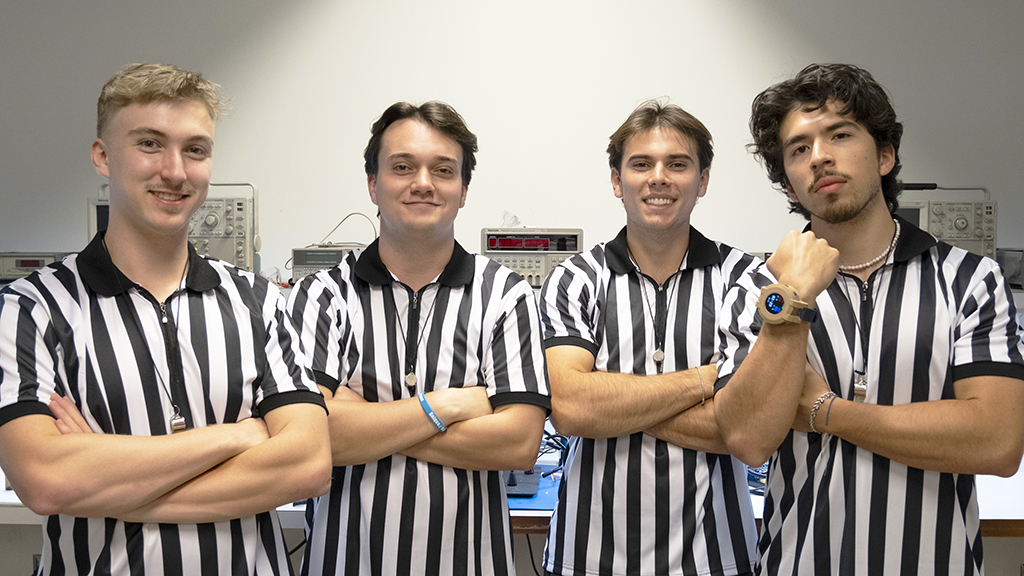
“As a group, we all share a strong interest in sports, which naturally influenced our brainstorming process,” Dionisio says. “We went through a variety of project ideas before ultimately landing on ScoreWatch, which combined a variety of our technical skills with our love of intramurals and sports.”
The device integrates an ESP32-based microcontroller with a round LCD display and Bluetooth low-energy communication to transmit real-time game data to external devices such as laptops or mobile devices.

“We approached the project from a system-level perspective, making sure the hardware, firmware and communication components operated seamlessly together,” Quintero says.
The group prioritized reliability and aimed to keep the design simple and intuitive. Throughout development, they tested regularly and sought continuous improvement to refine system performance and user experience.
ScoreWatch was developed to address a gap in in-game sports management.
“Our system aims to improve accessibility and efficiency for coaches, referees and recreational players by replacing traditional scorekeeping or costly infrastructure with a portable, easy-to-use alternative,” Lipp says.
Lipp adds that it also demonstrates how embedded systems and wireless technologies can be applied to tangible problems, with potential expansion into training analytics and officiating tools in many sports.
While the team did not partner with a formal industry sponsor, they worked closely with John T. Lewis, a director of business development in the Fulton Schools and their capstone mentor.
The team structured their workflow using tools like GitHub and Jira. That structure helped them manage development like professional engineers, reinforcing communication and accountability throughout the process.
By the time a working prototype was developed, the team had invested more than 200 hours into the project.
“That time reflects more than just technical effort — it shows ownership,” Lipp says. “Choosing our own project kept us engaged from start to finish, pushing us to solve problems and deliver a system we could stand behind.”
For the capstone team, ScoreWatch is both a functional device and documentation of how they’ve grown as engineers — taking an idea, building it from the ground up and proving it works on and off the court.
Embracing the experience
As students prepare to demonstrate their final research and projects, an equally valuable takeaway is the capstone experience itself, preparing them for transitions into graduate students and working in industry roles addressing new challenges.
“The capstone experience has showcased how I’ve progressed as an electrical engineer,” Nguyen says. “Comparing this effort to projects from my first semester highlights what I’ve learned both in terms of technical ability and teamwork. The skills involved in working on this project as part of a team for a common customer will transfer over to wherever life leads me.”
Phipps said the experience of the capstone project was just as important to the output.
“This capstone experience prepared us for our careers by giving us hands-on experience developing an evolving product from concept to working prototype,” Phipps says. “Personally, it strengthened my ability to collaborate on a team, solve open-ended problems and balance technical performance with real-world design limitations.”