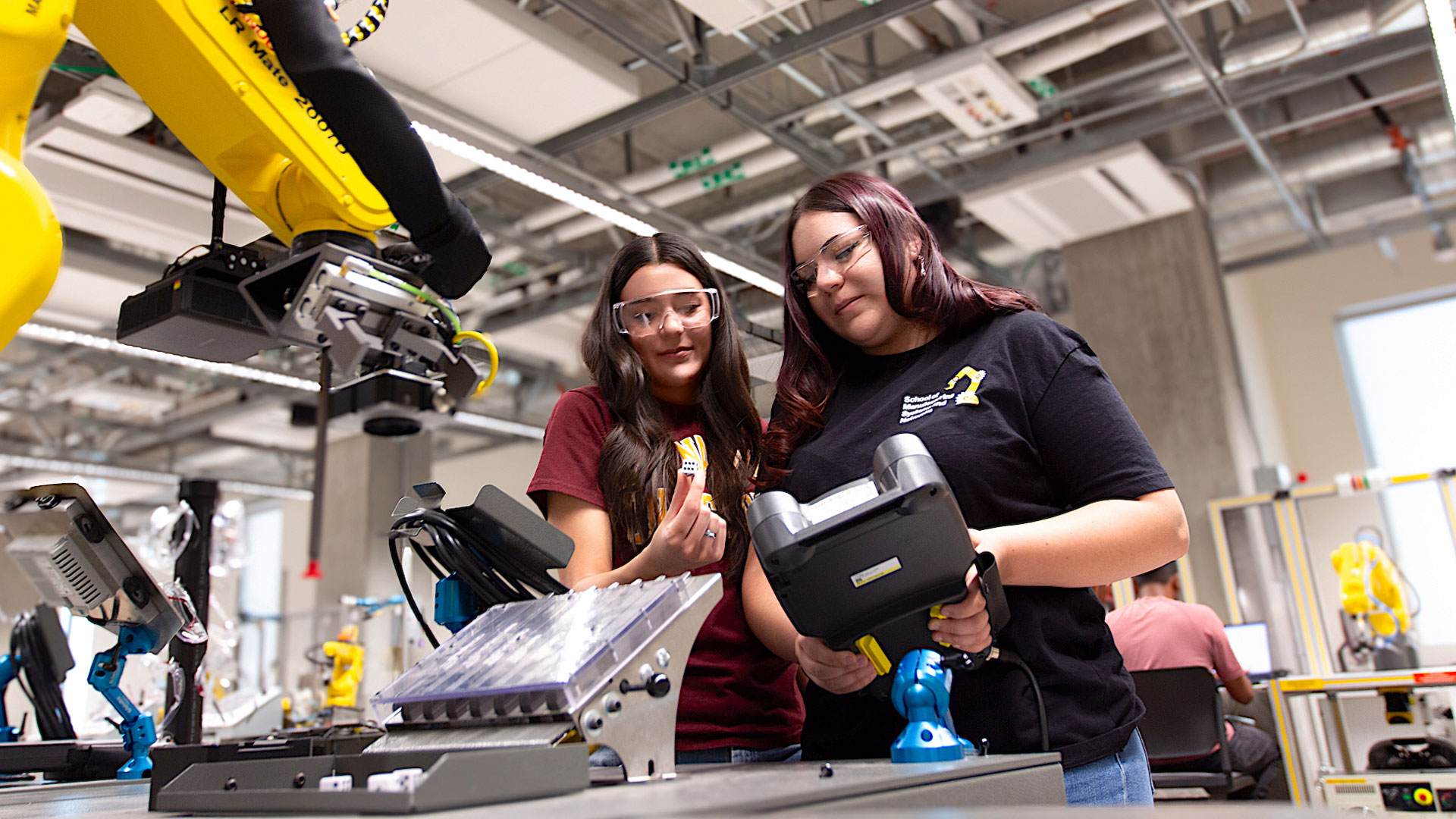
Manufacturing engineering shapes how ideas move from design to production, and the next generation of engineers must understand that process from multiple angles.
In the School of Manufacturing Systems and Networks, part of the Ira A. Fulton Schools of Engineering at Arizona State University, students move through programs designed to connect real-world production environments, systems integration and strategic problem-solving. For some families, that opportunity has become a shared experience.
The unique degree pathways for manufacturing engineering, which are offered at bachelor’s, master’s and doctoral levels at ASU, allow students to grow without leaving their academic ecosystem. For four sibling pairs, it means building technical skills while sharing mentors, labs and even car rides. For the industry, it means workforce-ready talent equipped at every stage.
What connects these siblings is not a single career goal. It is a shared love for building, troubleshooting and making systems work.
The Echegaray sisters: Choosing a focus and building a pathway
For some students, the journey to manufacturing engineering begins with early exposure to the field and quickly expands into hands-on experience through internships and applied coursework.
Prior to college, both of the Echegaray sisters attended Tucson’s Desert View High School, where they built a strong technical foundation. There, they participated in the iSTEM Academy and Precision Manufacturing program, fulfilling real customer part requests using SolidWorks, computer-aided design, or CAD, and computer-aided manufacturing, or CAM. Through the program, they built a technical foundation that continues to support their success in engineering today.
Lexana Echegaray, a manufacturing engineering undergraduate student at ASU, began her academic career in mechanical engineering before realizing she wanted a more specialized focus.
Conversations with faculty members, peers and academic advisors helped her see that manufacturing engineering aligned more closely with her interests and career goals.
“I found out that there is so much you can do in the world of manufacturing,” she says. “In my case, specializing in manufacturing engineering was a better fit for me than staying broad.”
Through the program, she deepened her understanding of manufacturing processes, systems and quality control while gaining experience that translates directly to practical applications.
Her younger sister, Jenavieve Echegaray, arrived at ASU with her sights set on manufacturing engineering. Her early exposure to computer numerical control, or CNC, machining, in high school helped shape that decision and positioned her to take advantage of opportunities early in her college experience.
During E2, a weekend-long experience for incoming engineering students, Jenavieve connected with faculty members who helped her secure an internship at Nammo Defense Systems. There, she optimized tooling processes on a high-precision, rigid machine tool called an Okuma CNC lathe, increasing part output and efficiency. The experience reinforced what she was learning in class and showed her how process improvement translates to industry impact.
“The manufacturing engineering classes I’m taking now flow right into industry,” she says. “If I had taken these before my internship, they definitely would have prepared me a lot more for the troubleshooting ahead.”
Both sisters are native Pascua Yaqui tribe members and recipients of the President Barack Obama Scholarship. They will both graduate in spring 2027 and each plan to continue their studies through the Accelerated Master’s degree program.
The sisters emphasize that their sibling dynamic has shifted over time.
“I used to be competitive with Jenavieve,” Lexana says. “But now, I just want her to succeed alongside me.”
Today, they attend each other’s leadership events across campuses and share what they’re learning individually to help make each other stronger students and engineers.

The Peavy brothers: From garage tinkering to industry-ready skills
For Aaron Peavy and Cameron Peavy, years of projects at home laid the groundwork for their path to manufacturing engineering. Homeschooled from elementary to high school, they spent years working on projects together, including a total rebuild of a 1960 vintage metal lathe in their garage.
“It’s an on-and-off project that we do in our spare time,” Cameron says. “It’s been really fun having something to work on together.”
After starting community college, both brothers transferred into the bachelor’s degree program in manufacturing engineering at ASU. Aaron was drawn to the program’s hands-on approach, where classroom learning is reinforced through machining labs, technical projects and industry-aligned coursework.
Faculty mentorship elevated that experience. Aaron credits Teaching Professor Jerry Gintz in the School of Manufacturing Systems and Networks for reinforcing professional standards.
“We learned how to produce quality work, something you could turn in to your boss in the real world,” Aaron says. “Professor Gintz really reiterated the importance of technical documentation like concise written materials and high-quality presentations.”
Cameron was inspired by his brother’s interest in engineering and followed a similar path.
“Going to the same college as Aaron has been a really great experience for us both,” Cameron says. “We often get to drive to school together, which means we only have to pay for one parking pass!”
But their collaboration goes deeper than convenience.
“We enjoy working together because we both understand what the other is capable of,” Cameron says. “It’s easy to delegate work between the two of us.”
After graduating at the end of this semester, Aaron is seeking opportunities in the automotive, mining or aerospace industries. Cameron, who will graduate in 2028, hopes to work in a startup environment focused on milling, CNC machining or 3D modeling.

The Hayes brothers: Gaining an upper hand
At the graduate level, students deepen their skills through advanced manufacturing research and specialization in areas like robotics, lifecycle engineering and semiconductor systems.
Todd Hayes and Tyler Hayes, both manufacturing engineering students graduating with their master’s degrees this spring, prefer building and testing over theoretical design.
Tyler found his turning point in undergraduate manufacturing electives, where he was first introduced to the machining and production processes that now inform his graduate research.
“I had so much fun in those electives,” he says. “If you apply yourself correctly, you get to play with some pretty cool machines.”
Today, his applied graduate project centers on reverse engineering a legacy mechanical assembly — scanning components without manuals, converting the geometry into refined CAD models and generating documentation so future suppliers can reproduce and maintain the system. The project blends technical precision with lifecycle thinking.
Tyler also represents the Scalable Asymmetric Lifecycle Engagement, or SCALE, team at national conferences, building connections in advanced manufacturing and semiconductor workforce development.
“Me and my research group got flown out to D.C. to network with other students from around the country,” Tyler says. “We even ran into Dr. Michael Crow on the flight back!”
He values the relationships formed with his peers through regular study sessions and faculty mentorship, which he says has opened doors for meaningful and lifelong connections.

Todd focuses on robotics and systems integration, building on the manufacturing foundation he developed as an undergraduate student.
“I felt manufacturing gave me the upper hand in making things move rather than just designing them,” Todd says.
Through the master’s program, he expanded both his design and production expertise.
Outside the classroom, Todd applies those skills at the ASU Bike Co-Op, repairing and managing campus rental bikes. The role reinforces troubleshooting and systems thinking as he diagnoses mechanical issues, performs repairs and helps maintain a critical campus resource.
The brothers’ paths reflect multiple directions students can take at the graduate level — one focused on repair and overhaul, the other on integration and automation — both demonstrating how the program supports deeper specialization within the manufacturing ecosystem.
“I think I’m more competitive than Tyler,” Todd jokes. “But luckily, we like different enough things that it works out well in the end.”

The Okun brothers: From learning to leading
Some students move through all manufacturing engineering offerings, advancing from undergraduate learning to graduate research and, in some cases, into teaching and mentorship roles within the same program.
Jake Okun and Zack Okun were drawn to manufacturing engineering driven by a curiosity about how things work. Growing up, they designed and built solutions together in school competitions, naturally gravitating toward engineering.
Jake, who graduated with his bachelor’s degree in manufacturing engineering in 2024, was drawn to the systems-level perspective embedded in the curriculum.
“The program emphasizes how automation, robotics, data analytics and human factors operate within interconnected systems,” he says.
After completing his bachelor’s and master’s degrees at ASU, Jake continued into the systems engineering doctoral degree program and now serves as an instructional professional in the School of Manufacturing Systems and Networks.
His path reflects a progression from student to mentor, contributing to the same program that shaped his academic and professional development.
“There is a profound sense of responsibility and gratitude,” he says of returning as faculty.
For Zack, the appeal of the manufacturing engineering bachelor’s degree program was its applied nature and industry relevance.
“There’s a growing demand for skilled manufacturing professionals,” Zack says. “Knowing that I’d be entering a field with both opportunity and long-term stability reinforced my decision.”
Blending creativity, problem-solving and tangible impact, he sees this field as foundational to technology commercialization, where ideas transition from concept to scalable solutions. Zack plans to graduate in spring 2026.
“Manufacturing is rapidly becoming more intelligent and interconnected,” Zack says. “I see the industry continuing to move toward smarter, more efficient and more sustainable systems.”
As second-generation Sun Devils, their journeys reflect both a continuation of a family legacy and the program’s ability to support students from entry through advanced study and into leadership roles.
One discipline, endless possibilities
Across these families, manufacturing engineering serves different roles at different stages. Some students move directly into industry, applying what they have learned to a fast-evolving, high-tech manufacturing landscape. Others continue graduate research, advancing the systems, tools and processes that will shape the future of manufacturing.
The School of Manufacturing Systems and Networks provides a program structure that supports that progression, allowing students to build on foundational skills, specialize in advanced areas and transition into careers that meet industry demand.
While these siblings’ journeys unfold side by side, they’ll leave with distinct experiences that enable them to fulfill personal ambitions, build better systems and contribute across the full manufacturing ecosystem.