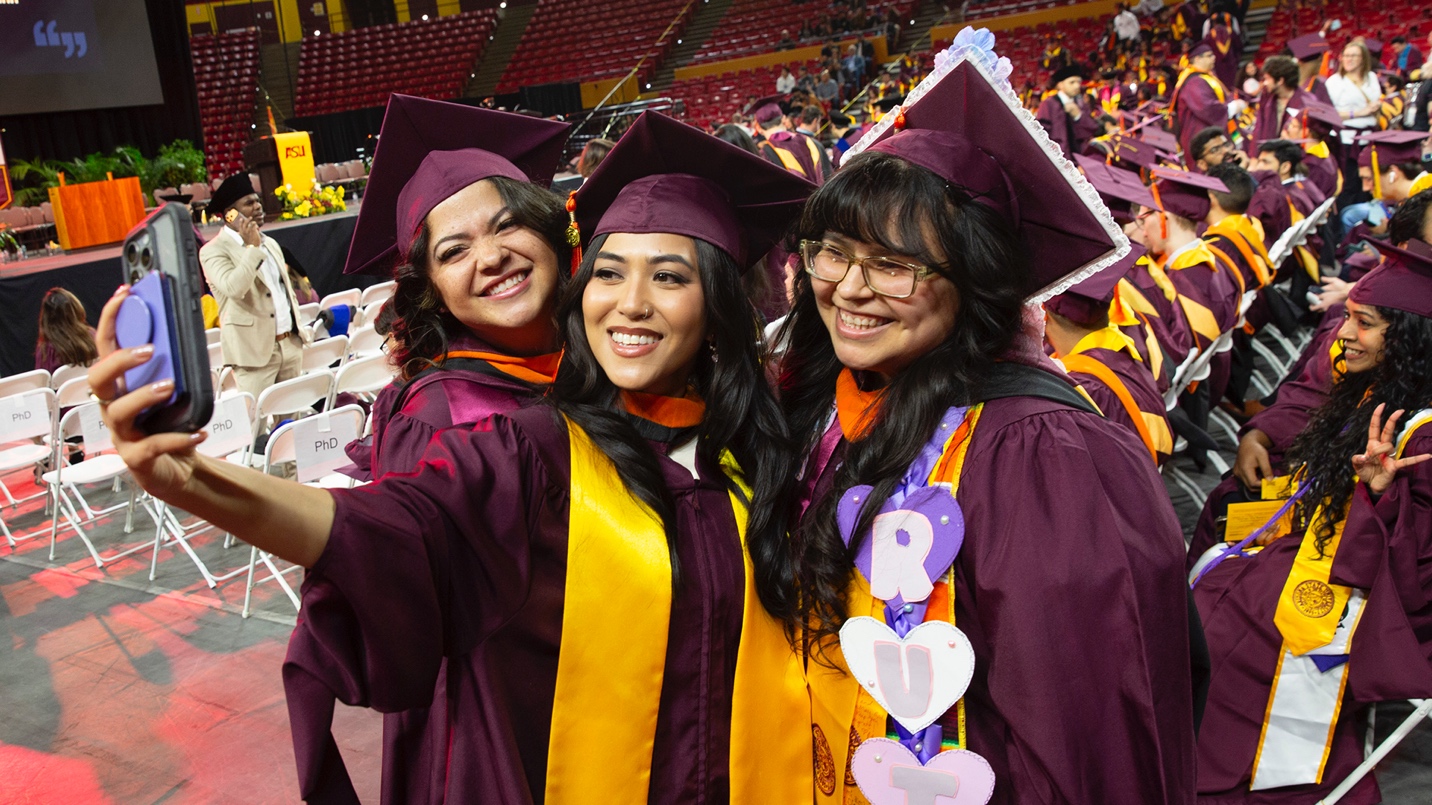
The three students weren’t in the same place when the group project hit a snag. The evening found Salina Valentin in Tempe, Arizona, Ruth Chavez in California’s Imperial Valley, and Mae Louise Geiskopf juggling family life from a home that kept moving. What connected them was a shared online document, a group chat and a determination to figure it out together.
The assignment was simple in theory: a design-of-experiments project to figure out the best way to apply thermal paste to a processor card. In practice, it meant late-night calls, careful control of room temperature and humidity, and arguing in real time over whether the “crisscross” or “spread” technique produced fewer thermal spikes.
When the results didn’t behave as expected, they didn’t splinter into silence or default to one person taking over. They stayed in the conversation.
“A lot of group projects turn into one person doing everything,” Valentin says. “That wasn’t us. Nobody felt like a burden or like they had to carry the team. We were all just there, figuring it out together.”
In the fall of 2025, Valentin, Chavez and Geiskopf were three students in the industrial engineering master’s degree program offered by the School of Computing and Augmented Intelligence, part of the Ira A. Fulton Schools of Engineering at Arizona State University.
All three were enrolled in the Fulton Schools Accelerated Master’s program through ASU Online, which carried them from bachelor’s degrees in engineering management earned in May 2024 to master’s degrees completed the following year. They arrived at the program from different places and for different reasons, but shared a common reality: family obligations, unpredictable schedules and the need for an education flexible enough to fit real life.
By the time the lights went up at convocation in December, they stood together in a single photograph — degree holders in hand and bonded by a friendship forged quietly in discussion boards, online group chats and the shared pressure of a fast-paced program.
Moments, mentorship and momentum
For Chavez, the online format wasn’t a convenience. It was the reason she was able to attend college at all. Raised in California’s Imperial Valley, she became the first in her family to pursue higher education while helping care for a sick sibling and supporting a large household. Industrial engineering appealed to her for its focus on systems, processes and problem-solving. Studying online provided a way to build a future in technology without stepping away from her family or community.
Valentin’s path began with a quiz on ASU’s website that pointed her toward engineering. It tapped into a childhood habit of making things and thinking about processes. Although she lives in Tempe, Arizona, a campus visit helped the single mother realize that an in-person schedule wouldn’t fit her family’s needs.
Geiskopf was balancing a restaurant-management career, a chef husband’s unpredictable schedule and a young child when she decided to pursue a master’s degree. Industrial engineering appealed to her because it combined business, management and technical engineering in a way that matched her process-driven approach to work.
The students connected in classes taught by Cheryl Jennings, a Fulton Schools associate teaching professor of industrial engineering. Their conversations on the online discussion boards migrated to Discord and text chains, where they scheduled study sessions, edited documents in real time, and solved problems collaboratively.
Jennings watched that connection deepen.
“They were all strong, capable students on their own,” she says, “but what stood out was how they supported each other. I loved watching them thrive, not just academically, but as a team that knew when to lean on one another.”
That kind of community doesn’t always happen organically in online education, but when it does, it can be transformative.
“If you don’t see it, create it,” Geiskopf says.
Faculty mattered, too. Jennings left a lasting impression on Valentin during her capstone project, when an early proposal was denied by the review committee. Rather than offering a quick fix, Jennings asked probing questions that forced Valentin to rethink her approach. The result was one of Valentin’s most meaningful projects.
“Dr. Jennings’ feedback is constructive by definition,” Valentin says. “She’s honestly a blessing to have at ASU.”
From screens to support
Their online ties hardened into real-world rituals. The three coordinated experiments, shared proctoring horror stories and kept one another from quitting when school collided with life.
Chavez says the friendship filled a gap she hadn’t expected.
“I was navigating everything on my own at first,” she says. “But once I met Salina and Mae, I didn’t feel as alone anymore. I had people I could turn to, not just for school, but for everything.”
For Valentin, the friendship became an anchor as she balanced motherhood with the demands of an accelerated degree program. Chavez was the steady presence, the voice that pulled her back when exhaustion or doubt set in. Geiskopf, meanwhile, was the person who related to both the academic pressure and the emotional weight of trying to be fully present as a mother and a student.
“They both challenged me,” Valentin says. “We would go back and forth, really deliberate about things, and come to a clearer understanding. You don’t get that in a lot of friendships.”
For Geiskopf, the bond was equally personal and deeply motivating. As a mother also balancing work, school and family, she found inspiration in watching Valentin do the same, often with little outside support.
“Salina works, goes to school and takes care of her daughter. She doesn’t miss a dance class or a performance,” Geiskopf says, adding that seeing that level of commitment reshaped what felt possible. “I thought, if she can do it, I can do it. It gave me so much hope.”
Looking back, all three students agree that the difference was a sense of community they built along the way. They advise students in online programs to speak up, ask questions or start their own study groups from scratch. The program can be demanding, they say, but it is possible to succeed without giving up the people and priorities that matter most.
As Valentin, Chavez and Geiskopf move forward in their careers, they say they are leaving with the confidence that comes from succeeding in a demanding program and with a support system that will last well beyond graduation day.
Watch Mae Louise Geiskopf discuss her master’s degree in industrial engineering:


