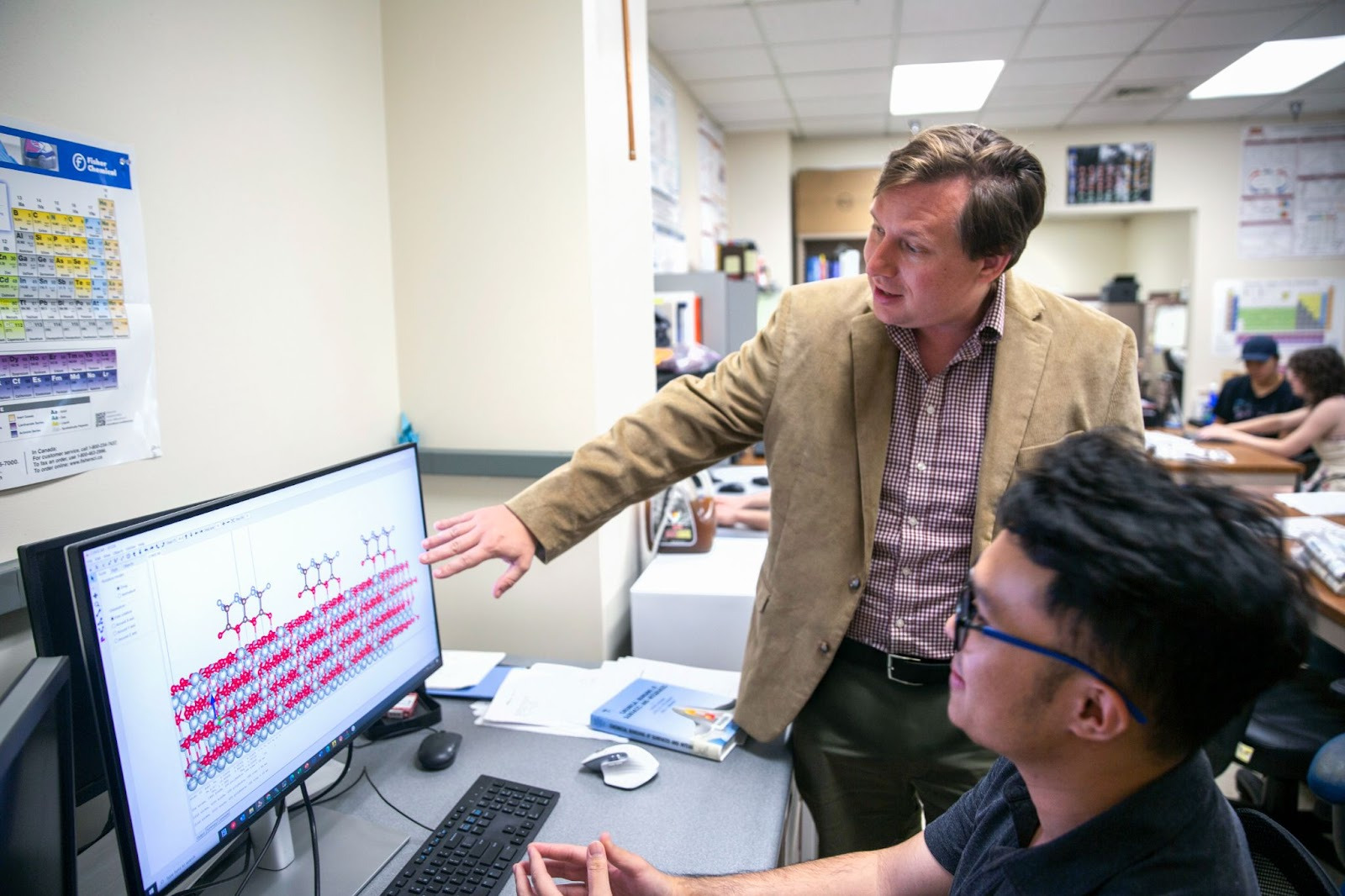
Chris Muhich has just secured a once-in-a-career opportunity.
An associate professor of chemical engineering in the School for Engineering of Matter, Transport and Energy, part of the Ira A. Fulton Schools of Engineering at Arizona State University, Muhich was recently awarded the Humboldt Research Fellowship.
The fellowship is a highly competitive international program that supports collaborations between researchers worldwide and German institutions, attracting thousands of applicants across disciplines each year, with only 20% to 25% ultimately selected.
Muhich is among those chosen to spend three months each summer in Germany over the next three years.
“It’s going to be very, very cool,” says Muhich.
He’ll be collaborating with Professor Martin Kaupp, a leading quantum chemist at Technische Universität Berlin, or TU Berlin, to tackle a challenge that limits the reliable production of cleaner fuels and other essential chemicals used in everyday life.
Understanding molecules from lines on a screen
Muhich says that to innovate a chemical process, one must first fully understand it.
Nuclear magnetic resonance, or NMR, is a widely used technique among chemists, chemical engineers and scientists for studying the structure and behavior of molecules. Kaupp is one of the world’s leading experts in calculating NMR spectra from first principles, meaning he uses fundamental laws of quantum mechanics to predict how molecules should behave.
Much like a magnetic resonance imaging, or MRI, helps doctors diagnose disease by revealing detailed images of the body’s internal structure without invasive surgery, NMR uses powerful magnets to examine how atoms are arranged inside molecules. Unlike an MRI, however, NMR does not produce vivid images. Instead, it generates complex signals — essentially squiggles on a screen — that scientists must carefully interpret to determine molecular structure. That’s where Muhich comes in.
For years, Muhich has been developing novel ways to study environmental and renewable energy-based chemical reactions with a goal to design materials that enhance them. Using the supercomputers available at ASU, he combines quantum chemistry simulations with machine learning to predict the ideal NMR signals for specific atomic arrangements.
Specifically, Muhich and Kaupp will focus on understanding zeolites, a type of solid material widely used in fuel refining and renewable energy, to catalyze chemical reactions. The same feature that makes zeolites useful as catalysts is what makes them incredibly difficult to study. The materials have networks of many tiny pores. Muhich compares a zeolite to a sponge — with holes or channels through which molecules in a liquid or gas state can move during a chemical reaction.
The molecular structure of a zeolite determines what reactions it can facilitate. While inferring the overall structure of a zeolite is relatively easy, Muhich says understanding the atomic arrangement of atoms required for a particular reaction is much more complex due to one critical fact.
“Most zeolites have defects, which just means there’s either extra or not enough atoms, leading to excess or missing electrons or protons,” he says. “The availability or lack of electrons and protons is what enables the molecules from the gas phase or the liquid phase to react within the zeolite. The issue is that while NMR lets us find out where the defects are, it’s really hard to know the atomic arrangement leading to the signal by just looking at the scan.”
He adds that the reverse process is far more difficult. Even with a supercomputer, predicting the expected NMR signal for a single zeolite structure can take up to a week.
Taking the guesswork out of engineering cleaner energy
Traditionally, chemists begin by guessing a zeolite molecule’s possible atomic structure that could enable a particular chemical reaction. Then, they use density functional theory to calculate what the corresponding NMR signal should look like, which takes a long time and a lot of computing power.
Only after those calculations are complete can researchers compare the simulated signal to experimental data and determine whether their guess was correct. That slow, trial-and-error process makes engineering new catalysts for cleaner energy sources and other everyday chemicals expensive and, at times, impractical.
Muhich plans to introduce artificial intelligence, or AI, into the workflow to help accelerate how researchers identify the molecular structures associated with NMR signals. By training the model on known zeolite structures and their NMR responses calculated through density functional theory, the AI can learn the relationships between atomic structure and NMR spectra, allowing researchers to rapidly identify which structural features are most likely to facilitate certain chemical reactions.
Together, they will develop an open-source software tool that allows researchers to input an NMR spectrum and rapidly obtain the most likely molecular structure responsible for it.
More than a fellowship
Muhich plans to make the first of his three trips to Germany this summer, where he’ll spend three months immersed in a new research environment and way of life.
Beyond exploring Germany and Europe, Muhich is eager to learn from Kaupp’s decades of experience and to combine their distinct expertise to improve a process that is fundamental to modern society.
“There are a lot of choices you can make and shortcuts you can take while doing NMR calculations,” Muhich says. “Professor Kaupp and his group have developed the methods on how to reliably take those shortcuts, and they’re going to help me understand and refine how we’re doing the calculations.”
Through the fellowship, the two researchers are embarking on a journey to create a tool that could make developing new chemicals across industries faster and more cost-effective, something neither could accomplish on their own within the same timeframe.


