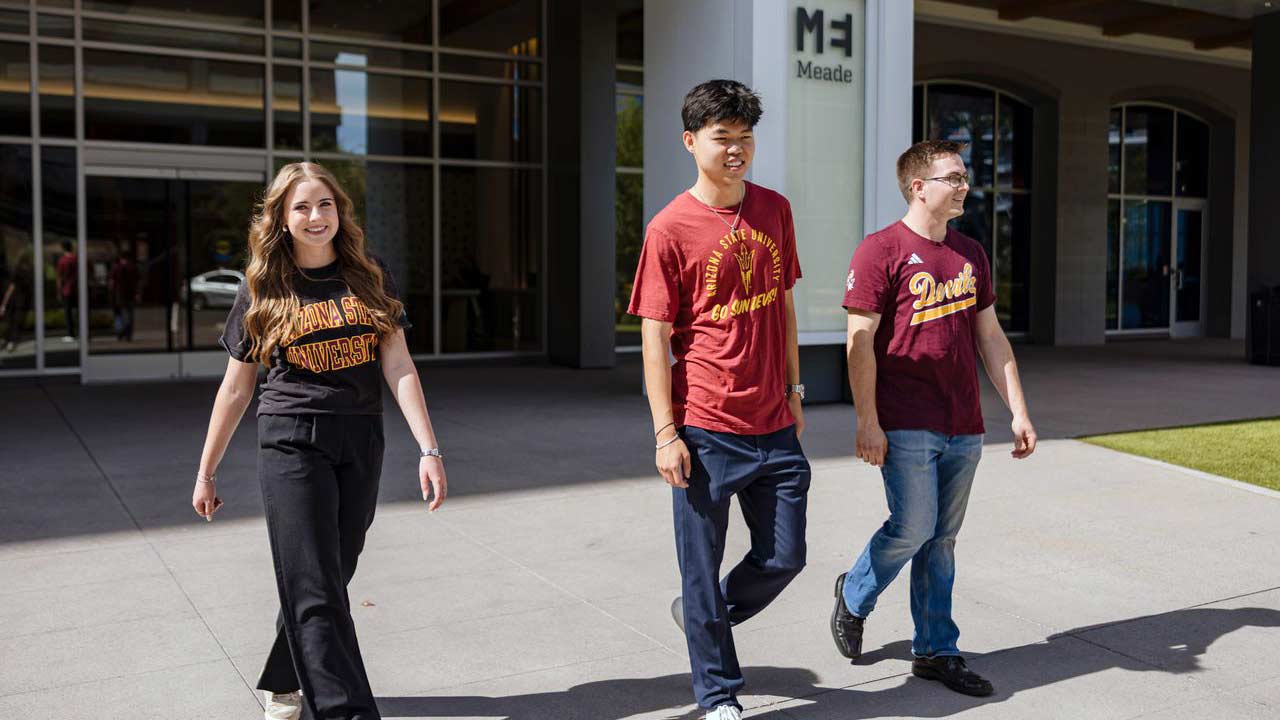
This summer, a cohort of five engineering students from the Ira A. Fulton Schools of Engineering at Arizona State University traded lecture halls for project meetings, site visits and engineering design reviews. Through a new 12-week internship program at Meade, they applied their classroom knowledge to the design of commercial and other complex facilities, gaining hands-on experience with multidisciplinary systems.
The program is part of a growing collaboration between the Fulton Schools and Meade to build a direct pathway for students interested in designing complex facilities using mechanical, electrical, and plumbing engineering.
The company’s ties to ASU extend across two generations. For John Meade, CEO of Meade and a graduate of the W. P. Carey School of Business at ASU, investing in students is a natural extension of the company’s values.
John’s father, Rob Meade, an ASU mechanical engineering graduate, founded the company guided by a simple philosophy: build an engineering firm clients can trust by delivering exceptional technical work, developing lasting relationships and taking responsibility for overcoming difficult problems. John has continued that vision while expanding the company’s reach and committing to investing in its future employees.
“I’ve come to believe that culture isn’t something that just sits alongside the business — it is the business,” John says. “The best engineers have options. A strong culture is what attracts great people, helps them do their best work and ultimately creates better outcomes for our clients.”
Through the internship, Meade is helping ASU advance the Changing Futures campaign’s goals of expanding educational access and preparing students for engineering careers.
The five interns, selected from about 300 applicants, tested their technical knowledge while learning how multidisciplinary engineering teams work together.
Learning beyond the classroom
Rather than assigning interns routine administrative work, Meade built a structured 12-week experience that blended technical training, professional development and hands-on collaboration. Students rotated through multiple departments, met with engineers from across the company, learned industry software, worked on a team capstone project and participated in networking and resume workshops designed to prepare them for engineering careers.
For mechanical engineering junior Isabelle Miller, the rotational structure gave her a broader view of the field.
“I really liked that it wasn’t just shadowing,” she says. “Being able to see how different engineering disciplines interact on a project really broadened my perspective.”
Working together, the interns designed the mechanical, electrical and plumbing systems for a commercial building using advanced software. Along the way, they learned how classroom concepts — from thermodynamics to engineering calculations — inform the design of building systems.
“In school you’re learning all these concepts mathematically,” Miller says. “Here, you actually see those calculations come to life through an HVAC system and through the software.”
Students encountered unfamiliar software, changing building codes and design challenges without step-by-step instructions. Instead of waiting for answers, they learned to research solutions, collaborate with teammates and seek guidance from experienced engineers.
Electrical engineering senior Conner Mickelson says that the capstone project experience fundamentally changed how he thinks about engineering.
“School sets you up to learn how to solve certain kinds of problems,” he says. “Here it was, ‘Here’s the information. Go build.’ I had to use what I knew to navigate new tools and find the resources I needed.”
Building infrastructure and boosting young professionals
While technical experience was central to the internship, students say the professional growth was equally valuable.
Throughout the summer, interns met with recruiters to learn how to strengthen their resumes, practiced networking and connected with engineers, project managers and business leaders across the company.
For mechanical engineering student Kevin Jiang, those experiences clarified for him what it takes to build a career.
“My main goal was to generate more opportunities,” Jiang says. “The resume sessions, networking and learning how to build your professional brand are things I hadn’t been challenged to consider before.”
Students also discovered that engineers need more than technical knowledge to be successful.
“There is no question our industry needs more engineers,” Meade says, “but the biggest shortage isn’t simply technical talent. It’s engineers who can combine strong technical ability with communication, ownership and sound judgment.”
Those qualities became increasingly evident to students as the internship progressed.
Meade program manager Taylor Johnson, who developed and leads the internship program, watched students grow more confident in their technical and communication skills each week.
“They’ve become immersed in the technical vocabulary,” Johnson says. “Now, they’re interacting with engineers and understanding what’s being discussed. They’re connecting what they’ve learned to real engineering work.”

Preparing students for a growing industry
This new internship opportunity comes as several technology-related industries, like semiconductor manufacturing, artificial intelligence and cloud computing, expand across the greater Phoenix area, and demand for engineers who understand mission-critical facilities is accelerating.
“Experiences like this help students understand how the fundamentals they learn in class inform decisions made across an engineering project,” says Kati Martinez, executive director of development for the Fulton Schools. “They also give students an early view of the communication and collaboration expected in professional practice.”
For the interns, site visits to active projects and data centers helped students connect design work with the infrastructure powering today’s digital economy.
“Seeing a finished data center and understanding that we get to be part of designing spaces like that was really fascinating,” Miller says.
Preparing students for industries like these requires close collaboration between universities and employers, Johnson says.
“People in the workplace are trying to figure out how to have more prepared engineers entering into their spaces, and universities are trying to figure out how to get engineering students employed,” she says. “It’s two sides of the same coin. Let’s come together and help each other.”
That collaboration reflects the company’s long-term commitment to Arizona and to the university that helped launch two generations of its leadership.
As Meade expands its internship program and scholarship support, it hopes to strengthen the pipeline connecting ASU students to enter the engineering workforce.
“Master the fundamentals. Be curious. Seek out internships and spend time in the field,” John says. “Your career won’t be defined only by the degree you earn. It will be defined by the problems you’re willing to take ownership of solving.”
Are you interested in unlocking future engineers’ potential through higher education? Join other supporters who are paving the way for a brighter future and learn more about how ASU is Changing Futures.