
Artificial intelligence, or AI, is changing the way designers approach creative challenges, by expanding what’s possible. For Lauren Crites, AI became a key tool for bringing her ideas to life.
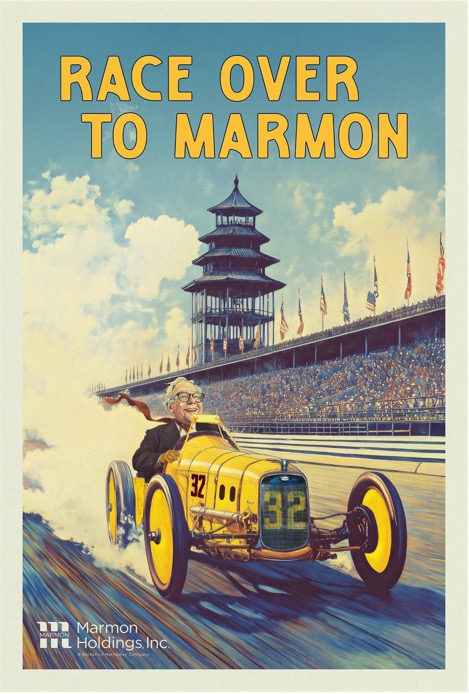
That innovative approach recently helped Crites, an instructor in the graphic information technology program at The Polytechnic School, part of the Ira A. Fulton Schools of Engineering at Arizona State University, earn the “Best of Show – Educator” distinction at the Print Creative Alliance Southwest Student Print Competition for her design of a vintage-style race car poster. While the recognition celebrates excellence in print design, it’s also a case study of how emerging AI tools are becoming part of the modern graphic designer’s creative process.
“Basically, I built the poster,” she says. “I just built it in AI, using many different images, and then painting it all together to be one cohesive design.”
The winning finished piece, titled “Race Over to Marmon,” stood out not only for its finished design but also for how it was created.
Building the poster, piece by piece
The project began as a commission for the Berkshire Hathaway annual shareholders meeting in 2025. The client wanted a vintage-style race car poster featuring the historic Marmon Wasp with Warren Buffett behind the wheel. There was just one problem: they had no artwork to provide, and Crites does not consider herself an illustrator.
So, she turned to AI as a creative partner.
The specific imagery Crites envisioned didn’t exist in any stock library; she turned to AI for source material, similar to how she’d otherwise turn to stock. Using AI image-generation tools, Crites began developing the artwork she envisioned. The process was far from as simple as entering a prompt. While AI helped lay the foundation for the illustration, she found herself pulling usable fragments from several AI-generated images and continually refining the results.
During the process, the tools also made mistakes. The race car, for example, didn’t accurately match the distinctive markings of the original Marmon Wasp, so she recreated those details herself and incorporated them into the composition.
Through multiple iterations, editing and digital painting with Adobe Photoshop, Crites combined elements from numerous AI-generated images into the final product. This process was similar to using stock images, except the specific imagery she envisioned didn’t exist in stock libraries.
From event poster to award winner
The finished poster became more than event artwork. It was enlarged into a giant display at the company’s shareholders meeting and became a photo opportunity for attendees, with Warren Buffett among those who posed in front of it. One of the photos later appeared in The Wall Street Journal.
Crites notes that she doesn’t typically enter design competitions but decided to submit her work after encouragement from a fellow faculty member. When it came time for her to choose a project for the Print Excellence Awards, this piece was the obvious choice.
Organized by the Print Creative Alliance, the awards recognize outstanding work from students, educators and companies across 13 Western states. The competition celebrates creativity, craftsmanship and innovation in today’s printing, imaging and graphic communications industries.
For Crites, the award affirms something she’s already seeing in the classroom and the profession: AI is becoming another tool in a designer’s toolbox. AI can generate new creative inspiration that was previously difficult to conceptualize, but success still depends on the designer’s vision, judgment and ability to refine an idea.
Bringing AI into the classroom
Crites’ recognition isn’t about one award-winning project. It reflects how graphic communications education is evolving alongside new creative technologies.
She teaches courses at the beginning, middle and end of the curriculum, giving her opportunities to introduce AI at different stages of her students’ development. She incorporates the technology when it supports a course’s learning objectives rather than making it a component of every class.
Overall, the goal is for her students to learn how to harness AI as a creative aid for exploring concepts and generating small elements that can be incorporated into a larger design, rather than relying on it to create a finished product.
“We’ve taken a human-centered approach to AI for decades at The Polytechnic School. With more accessible AI in the past few years, we underscore the importance of principled innovation as a necessary guide,” says Kurt Paterson, director of The Polytechnic School. “For design work like what Professor Crites is doing, it requires us to build our students’ foundation in visual media first, then teach them what modern design tools can and can’t do. The judgment about when a technology serves the work, and when it doesn’t, ultimately belongs to the designer.”
Crites sees value in teaching students how to use the technology as a resource and to streamline design strategies, especially for future designers who may work independently or for small businesses without large creative teams.
“I feel like AI is going to be the future of design,” she says. “We need to grasp using these tools and make it something that you use efficiently and responsibly.”
Her message to students is that they shouldn’t be afraid of the future.
“AI is a new tool, but don’t be afraid of trying something new,” Crites says. “Take on the work that you might not think you can accomplish or achieve, and you might surprise yourself.”


