When students begin their engineering education, there’s no way to predict where their work will take them. For most, projects remain in classrooms, laboratories or on computer screens. For a team of Arizona State University students, however, years of effort have reached Earth’s orbit.
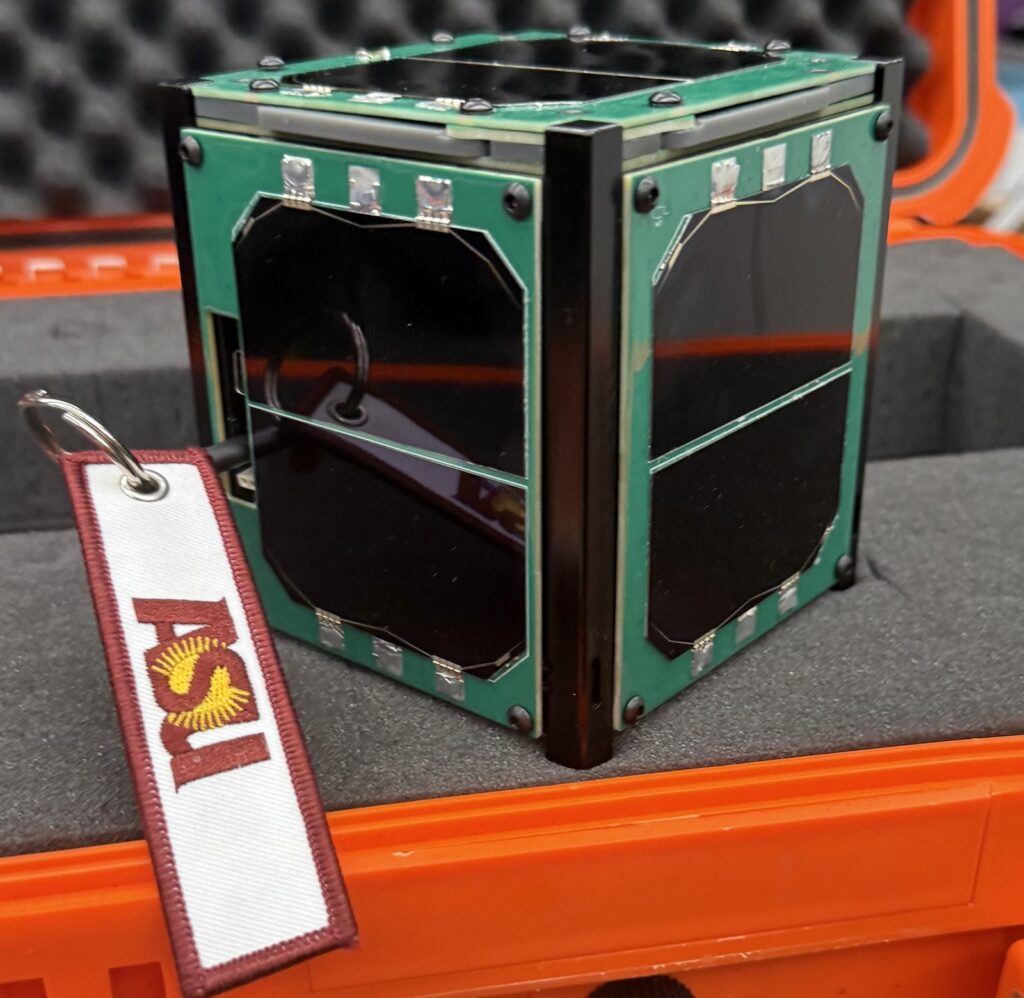
Throughout the last two years, students from Sun Devil Satellite Laboratory, or SDSL, designed, built and tested Coconut, a CubeSat — a miniaturized, cube-shaped satellite used for space research and technology demonstrations. The CubeSat was deployed from the International Space Station, or ISS, into Earth’s orbit.
For the students behind the mission, the deployment is a culmination of years of volunteer work, technical problem-solving and persistence. Ricardo Ontiveros, an electrical engineering alumnus from the School of Electrical, Computer and Energy Engineering, part of the Ira A. Fulton Schools of Engineering at ASU. Ontiveros graduated this spring and served as an electrical lead and later team lead on the project. He says the countless hours of volunteer work were undoubtedly worth the rare opportunity to see a spacecraft they built launch into space.
“When I finally watched my physical stress leave this planet, my body was shaking, trembling, trying to record it,” Ontiveros says. “I think that’s the big grand climax of what SDSL does. As students, we really are sending satellites to space.”
Coconut launched to the ISS aboard Northrop Grumman’s Cygnus NG-24 resupply mission earlier this year. After spending nearly three months aboard the station, the satellite was deployed into orbit.
Student-built satellite deployed from ISS
While in active orbit, Coconut can continuously transmit health and status information — often referred to as a “heartbeat” — allowing the team to monitor battery levels, communications performance and orbital data, which is intended to be detectable by amateur radio operators.
The CubeSat’s name comes from a simple observation made by students. Covered in dark solar panels and compact in shape, they thought it looked like a coconut. While the names may be playful, the engineering behind them is meticulous.
“The electronics and software on Coconut were developed entirely by students in the lab,” says Tyler Nielsen, the project lead and a computer systems engineering graduate from the School of Computing and Augmented Intelligence, part of the Fulton Schools. “We designed all the circuit boards, all the software, and did all the assembly.”
Students designed the spacecraft’s onboard computer, electrical power systems, communications hardware and software architecture. While the team purchased the aluminum frame that houses the satellite, nearly every other subsystem was designed, assembled and tested by students.
Coconut also changed how the team approaches spacecraft development. They documented hardware issues encountered during the mission and used those findings to improve similar systems on SquidSat. Just as importantly, the team reevaluated its development timeline after realizing how much time testing required.
Learning through challenges
Building a spacecraft is difficult under any circumstances. Building one as a volunteer student organization while balancing classes, jobs and other commitments is even harder.
Students spent years troubleshooting hardware, refining software and conducting extensive testing to ensure the spacecraft could survive launch and operate safely in orbit.
“You never quite realize how much time it takes to go from, ‘I built this,’ to, ‘I know this is going to work’ until you start doing it,” Nielsen says.
The team stress-tested batteries, evaluated solar arrays, performed communications tests and conducted long-distance radio experiments across the greater Phoenix area to verify the spacecraft’s ability to communicate with ground stations.
Because Coconut would travel to the ISS before deployment, safety standards were especially stringent.
“You only get one shot,” Ontiveros says. “You’ve got to make sure that what gets sent up there works. It’s a lot of hair-pulling and screaming in the lab, but ultimately, it’s a very rewarding feeling when you actually get it right.”
For many team members, the project’s defining moment came in April when they traveled to Florida to watch Coconut’s launch aboard a SpaceX rocket carrying the Cygnus NG-24 mission.
Students watched from the Kennedy Space Center area as the rocket lifted off from nearby Cape Canaveral Space Force Station and its booster returned to Earth.
Squid on deck
Although the team never established communication with Coconut after deployment, the mission provided invaluable lessons that are already shaping SDSL’s next spacecraft, SquidSat. Students documented hardware issues, refined their development process and rethought project priorities, using Coconut as the foundation for their next ambitious mission.
SquidSat began in October 2024 as a collaborative 3U CubeSat project involving ASU’s SDSL, Interplanetary Lab, Luminosity Lab and the Power Electronics and Energy Conversion Lab.
Unlike Coconut, which was developed primarily within SDSL, SquidSat is being designed as a modular CubeSat platform, or bus, that will support payloads developed by partner laboratories. The collaborative approach exposes students to the interdisciplinary teamwork common in the aerospace industry while increasing the mission’s scientific potential.
The new satellite also incorporates improvements informed directly by Coconut’s development. Students retained much of Coconut’s underlying architecture while redesigning hardware to improve redundancy and reliability for the larger spacecraft.
Aaron Bournais, a mechanical engineering student in the School for Engineering of Matter, Transport and Energy, part of the Fulton Schools, says their experiences with Coconut helped accelerate aspects of SquidSat.
“With SquidSat, we attempted to make hardware much faster,” he says. “The first versions weren’t as polished, but students could build, test and iterate repeatedly.”
Although the early hardware was less polished than Coconut’s initial designs, the faster development cycle gave students more opportunities to improve the spacecraft while gaining hands-on engineering experience.
An education beyond the classroom
SDSL projects provide opportunities that many students seldom encounter in traditional coursework. Unlike many research groups, SDSL projects are largely student-led, with volunteers responsible for technical decisions, project management and system design.
“We get guidance from advisors and professors, but students are making the decisions,” says Eric Marcu, an undergraduate aerospace engineering student and president of SDSL.
Students gain experience with industry-standard engineering processes, hardware development, testing, documentation and regulatory requirements.
For Nielsen, the project provided proof that the skills he developed in the classroom could be applied to real missions.
“Being able to say I worked on something that’s on the ISS and going to space is different,” he says. “It’s not something that sat on a desk or was just a school assignment.”
For current SDSL members, SquidSat represents an entirely different launch opportunity. By shortening development cycles and expanding collaboration across multiple research laboratories, the project is designed to give more students the opportunity to experience an entire satellite mission and engage in the aerospace industry before they graduate.
“To actually solder a circuit board that’s going to space, that you did with your own hands, and see the whole design from concept to testing to launch,” Ontiveros says, “is a huge achievement I’ll never forget.”