
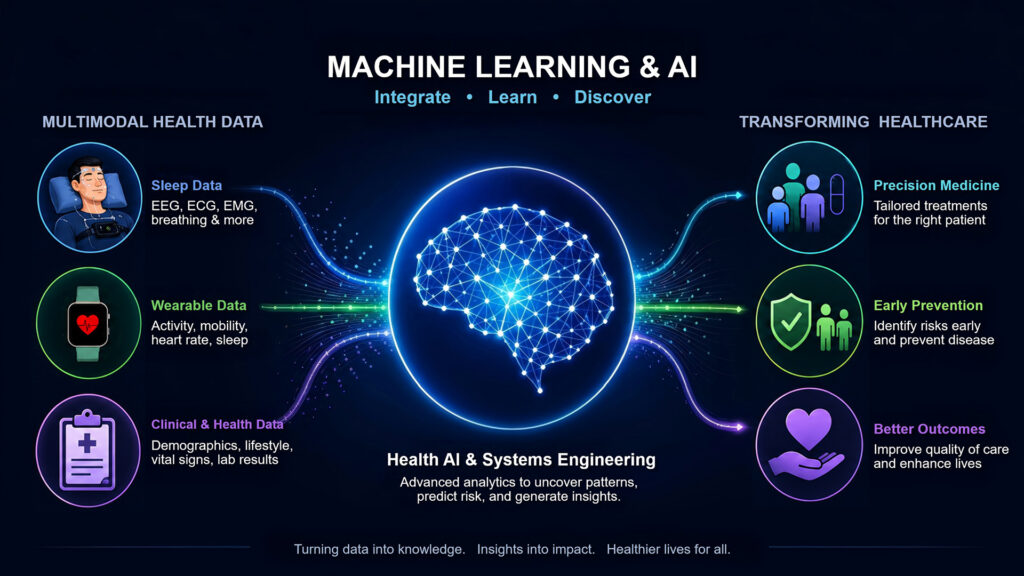
Health care has a data problem. Hospitals, clinics and wearable devices generate oceans of information, including sleep signals, medical scans and electronic health records. But much of it sits fragmented, siloed and underused.
The result is a paradox. Clinicians are awash in data, yet often starved for clear, actionable insight. A 2025 NIH summary on sleep and circadian health co-authored by Bing Si flagged a growing disconnect between unprecedented volumes of data and the lack of analytical tools to turn it into meaningful insight.
Si, an associate professor of industrial engineering in the School of Computing and Augmented Intelligence, part of the Ira A. Fulton Schools of Engineering at Arizona State University, wants to fix that. From sleep disorders to teen heart health and metabolic health, she designs artificial intelligence, or AI, systems that turn fragmented health data into practical tools for doctors and clinics.
“We really need to look at real-world medical problems to see where the challenges lie and how a data-driven approach can help,” Si says. “My lab collaborates with physicians, nurses and clinical scientists to rethink how health data can be used and redesign how care is delivered.”
Si approaches health care like an industrial engineer: a complex system full of bottlenecks, inefficiencies and missed opportunities. The problems she tackles are everywhere and sometimes hiding in plain sight.
A wake-up call for sleep apnea
Sleep apnea is one example. This common but chronically underdiagnosed condition linked is to cardiovascular disease, neurological decline and metabolic disorders. Diagnosing it today often involves sleep studies, in which patients spend a night wired to sensors while technicians spend hours manually reviewing data.
Si wants to automate the process.
Her team is developing AI models that can analyze sleep-study signals, including EEG, ECG and breathing patterns, to determine whether a patient has obstructive sleep apnea and even how severe it is.
One challenge is privacy. Health data is siloed by design. Si builds within that constraint, using federated learning, which lets hospitals share insights without sharing patient data. Her work might also increase the number of people who can complete at-home studies.
“Because of the burden to actually have sleep apnea diagnosed, automating the process could dramatically expand access,” Si says. “That means more patients getting treatment.”
Too young to worry? Think again
If sleep apnea is a problem of missed diagnosis, young adult cardiometabolic health is a problem of missed timing.
Heart attacks rarely strike young people. But the conditions that contribute to them, such as poor diet, inactivity and sleep deprivation, can begin early.
“We don’t expect someone young to have a heart attack tomorrow,” Si says. “But if risk factors go unaddressed, young people could face diabetes or cardiovascular disease later in life when it is harder to address.”
Her research, funded by the National Institutes of Health, or NIH, tackles this by rethinking how cardiometabolic risk is defined among late adolescents and young adults. Si uses machine learning to uncover hidden groups of patients with similar risk profiles.
That matters because cardiometabolic health is complex. Diet, sleep, mental health and exercise all interact, and traditional models struggle to capture that. By combining these signals, Si’s work surfaces patterns that doctors and patients can act on.
At the 2025 American College of Cardiology Annual Scientific Session, her team reported that people can be grouped based on shared health risks and that some of those groups were far more likely to develop conditions like diabetes and metabolic disease over time.
Si sees this as a bridge toward more personalized medicine. Her work groups patients with similar risk patterns, creating a starting point for more targeted, effective care.
In early results, that approach is already revealing blind spots. Some adolescents who appear healthy still carry elevated long-term risk due to factors like smoking or poor sleep. Others avoid those behaviors but show different, less visible vulnerabilities. Si’s work illustrates that risk doesn’t always look the way doctors expect it to, and treating everyone the same can mean missing the people who need help.
The system behind the symptoms
Across projects, a pattern emerges. Si wants to build the infrastructure for better decisions.
That work extends beyond diagnosis to how care is delivered. In a project funded by the Agency for Healthcare Research and Quality, or AHRQ, Si teamed up with nursing researchers to study why health screenings for issues like mental health and domestic violence are not consistently performed in primary care settings. Her team found that screening rates were shaped by factors ranging from provider training and workload to workplace culture and health care policies.
Si’s solution was to model the system itself. In her lab, she used data to uncover why key screenings were missed and highlighted where targeted changes could help health care providers catch problems earlier.
The result is a roadmap for improving care where it might fall short.

Coming home to build the future
That mindset was forged at ASU.
Si earned her doctoral degree in industrial engineering from the School of Computing and Augmented Intelligence in 2018 before launching a faculty career in New York, where her work in machine learning and health care quickly drew national attention and major NIH and AHRQ funding.
Now she’s back in Tempe, part of the Fulton Schools’ push to build a powerhouse in industrial engineering and AI. The return is more than symbolic. Si’s work depends on collaboration across disciplines, institutions and data silos, and ASU offers the ecosystem to do it.
“I feel like there are a lot of things now we can collaborate on,” she says.
At its core, her work reflects a different way of thinking about health care. Industrial engineering might not usually be associated with medicine, but Si sees it as a system that can be redesigned.
She’s engineering the systems that shape how disease is understood and treated.


