The recent Innovation Showcase/STEM Day event at Arizona State University’s West Valley campus put a spotlight on the quality of the educational experiences and research opportunities being provided to students through the School of Integrated Engineering, part of the Ira A. Fulton Schools of Engineering at ASU.
About 200 high school students from across the West Valley attended the May 1 event to learn more about science, technology and engineering and math, or STEM, projects and related activities.
The program and its displays of students’ STEM projects described and illustrated numerous research pursuits recently undertaken by students, provided details about what they have been gaining through a wide range of projects that are expanding their STEM knowledge and hands-on skills beyond what they’ve learned in the classroom.
“It’s been exciting to see the growth of our showcase event over the last two years,” says Shawn Jordan, the interim director of the School of Integrated Engineering. “This year we had 52 student projects spanning microelectronics, business, and computer science classes, and local industry partners alongside high school students from the West Valley visiting to be inspired by engineering.”
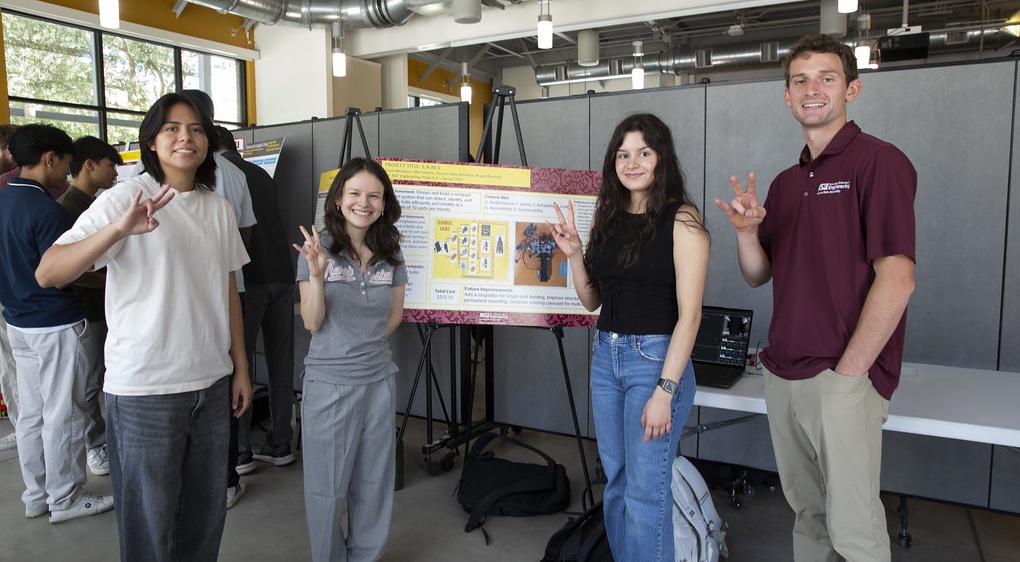
The exhibits also provided an overview of the range of what students are learning and the work they are doing that expands across a wide range of pursuits that will prepare them to be innovators in their engineering career pursuits, Jordan says.
Attending the event “was an incredibly valuable experience for both our Goodyear High School students and me in my role as an academic coach,” says Andrew Niemczyk, who serves as the school’s liaison connecting students to business professionals.
“It provided students with meaningful, hands-on learning opportunities that connected classroom concepts to real-world science, technology and engineering and math applications. From participating in the math escape room to collaborating during the engineering design challenge, students were actively engaged in problem-solving, critical thinking, teamwork, and creativity throughout the day,” Niemczyk says.
Such opportunities “enable students to envision themselves in college and professional environments while developing skills that will benefit them far beyond the classroom,” he adds. “The experience fosters collaboration and engagement in a way that traditional instruction alone cannot.”
Travis Kelley, a principal on the electrical management and microelectronics team at the Mercury Systems company, who earned an undergraduate degree in robotics engineering at ASU, says going through the degree program “is what made me into the engineer I am today, largely thanks to my participation in an Innovation Showcase in my junior and senior years” on ASU’s Polytechnic campus.
Kelley notes he is a supporter of the showcase, “because I feel in today’s job climate its more important than ever to have the ability to explain detailed designs that have taken months to complete to someone who has never taken an engineering class.”

The event “gives students the opportunity to get out of their comfort zones and engage with people who may not have a technical background,” he says, which he sees as a necessary and valuable skills to enable graduates to succeed in their engineering careers
Cassidy Tran, a senior coordinator of Student Success and Engagement in the Fulton Schools, who served as an advisor to students who produced projects for the Innovation Showcase, says one of the more rewarding experiences of being involved was seeing the professional growth and confidence students have developed in working on their projects.
“Many of these projects started as simple ideas discussed in advising meetings, classrooms, or brainstorming sessions I’ve sat in on, and to then watch those ideas turn into fully functioning prototypes, presentations, and things that shake and move was honestly amazing to see,” Tran says.
“What stood out most to me was not just the technical skill development, but the personal growth. Students who may have once been hesitant to speak up in class were confidently presenting their work, explaining complex concepts, answering questions, and engaging with the community around their projects,” she says.
“Seeing them take ownership of their ideas and proudly showcase their work was such a meaningful moment to me,” Tran adds. “As someone who works closely with these cohorts of students throughout their academic journeys, events like the Innovation Showcase are exciting because they represent a visible milestone in students’ development.”
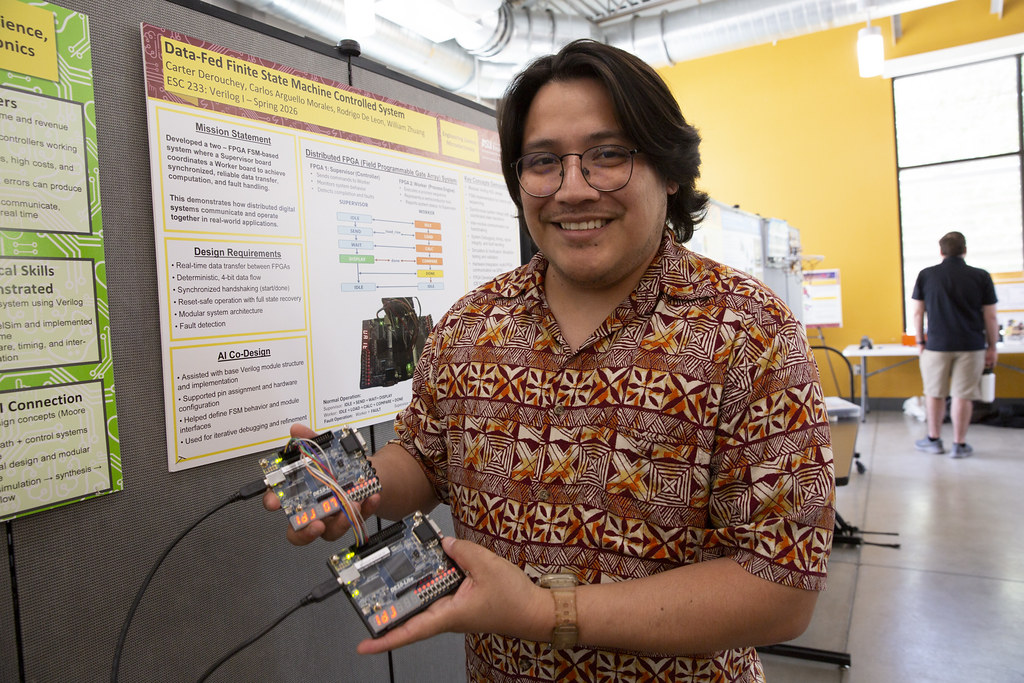
Fulton Schools computer science student Jose Mondragon worked with a team that completed a question and answer project. There are three roles in the system the team developed: students, administrator, and reviewer.
“The first user to log in is the admin, and other users choose between reviewer or student. An admin can invite other users to join the system, a student can ask questions and a reviewer can respond to questions,” Mondragon explains.
This is a basic Graphical User Interface, or GUI app, that enables interaction through the use of visual elements rather than typing text commands for discussions.
“I learned how to create a basic GUI using Java and Swing as the framework. I learned about elements, layouts, and event listeners. I plan on getting better at making GUIs, so I can make the display of my projects look better,” Mondragon says. “I learned people should be confident and happy about displaying their project, even if it’s not the best one there, because it’s the effort that counts.”
“The event provided an outstanding educational experience for our high school students and offered meaningful exposure to college-level engineering and STEM opportunities,” says Chuck Balogh, an engineering teacher at Ironwood High School in Glendale, Arizona.
“Our high school students appreciated the opportunity to observe projects closely aligned with concepts and technologies they have been studying in advanced engineering and STEM coursework,” Balogh says.
“Seeing college students present real-world applications of similar skills helped make their own classroom learning more tangible and meaningful, while also motivating them toward future educational pathways in STEM fields.”