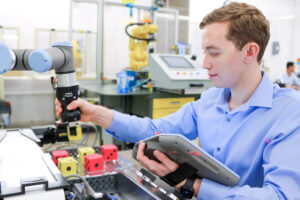
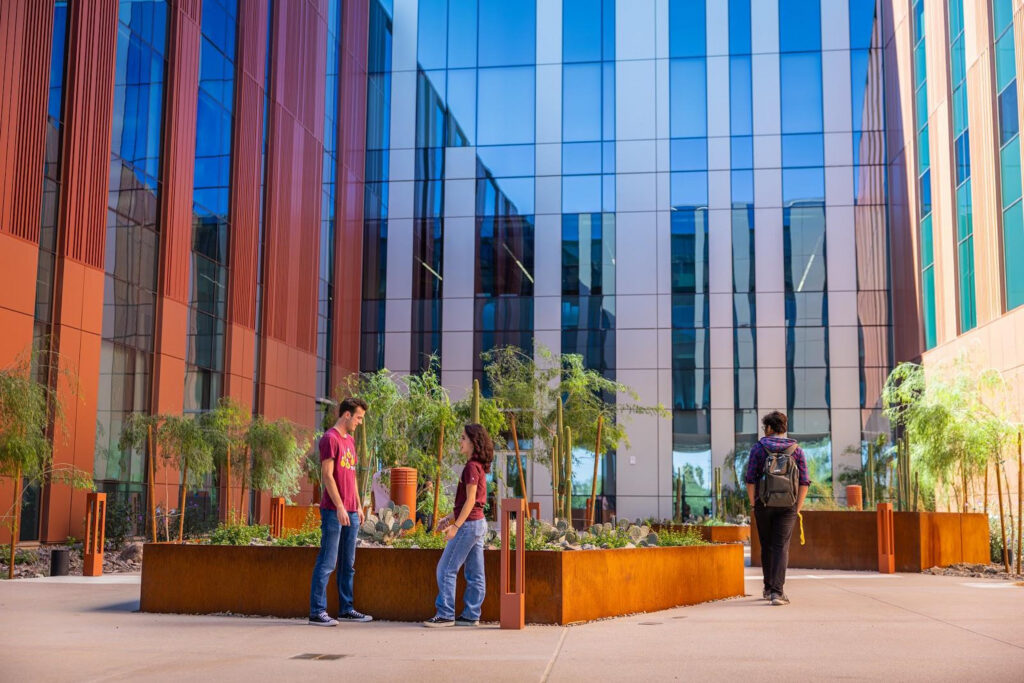
Interdisciplinary Science and Technology Building 12, or ISTB 12, opened on Arizona State University’s Polytechnic campus in October 2025 as part of the university’s broader efforts to expand advanced manufacturing education in the state.
Designed as a centralized hub, the facility is located within the Polytechnic Innovation Zone. It integrates instructional spaces and advanced research environments that support education across degree programs in the School of Manufacturing Systems and Networks, part of the Ira A. Fulton Schools of Engineering at ASU. Two academic programs that extensively use the building’s labs are the bachelor’s degree in engineering in robotics and autonomous systems and the bachelor’s degree in manufacturing engineering.
Just four months after its grand opening, ISTB 12 is already a hub of activity, housing courses, labs and community programs that engage the student body and beyond. On a typical weekday, more than 550 students cycle through the space.
The facility supports interdisciplinary work through shared labs where students and faculty conduct coursework and hands-on experimentation side by side, creating a vibrant knowledge exchange within one central location.
“Since the school’s formation nearly four years ago, this building represents a significant milestone for its academic and research programs,” says Binil Starly, school director and a professor of manufacturing engineering in the School of Manufacturing Systems and Networks. “ISTB 12 is unlike any other facility in the nation. The emphasis on laboratories and research spaces with state-of-the-art equipment defines the future of manufacturing.”
Industry interest and early student engagement
Industry leaders are regularly touring ISTB 12 to see how its equipment and lab spaces are being used to train the next generation of engineers. These visits create opportunities for faculty and industry to explore collaborations in research and training.
For example, Lallemand Baking, a global supplier of baking ingredients and fermentation solutions, recently visited to assess whether similar machinery could be applicable to its manufacturing operations.
Local and regional engineering companies are exploring potential collaborations in ISTB 12’s advanced labs, signaling growing interest in the facilities’ capabilities. Faculty members from the School of Manufacturing Systems and Networks are in active discussions with industry partners about shared lab use and joint projects, positioning ISTB 12 to support regional workforce development and applied research needs.
Beyond industry engagement, the building also connects with the wider ASU community: Its large classrooms host university-level general studies courses, as well as pre-college and community programs, like classes for ASU Prep Polytechnic.
This includes high school juniors and seniors on a FIRST Robotics team, who use a second-floor classroom weekly for their VEX robotics projects, offering hands-on experience with advanced equipment in a collaborative engineering environment.

Where research and automation converge
The Advanced Composite Lab in ISTB 12 anchors research led by Mostafa Yourdkhani, an associate professor of manufacturing engineering in the School of Manufacturing Systems and Networks. His team investigates rapid manufacturing methods for composite materials, using the building’s specialized equipment and flexible workspaces.
“This building is designed to accommodate large-scale manufacturing research, which is very unique,” Yourdkhani says. “Downstairs, we have industrial-grade robotic arms that support automation of manufacturing processes and multidisciplinary research collaborations.”
That flexibility has fostered innovative research on freeform 3D printing of polymers and composites, even in midair.
Robotics and artificial intelligence, or AI, shape daily coursework, particularly in advanced robotics classes that blend physical systems with intelligent decision-making. Graduate and undergraduate classes explore how automation, intelligent controls and data-driven processes intersect in modern manufacturing environments.
Ongoing research extends into the Robotics and Autonomous Systems Lab, a high-bay collaborative space where faculty and students investigate emerging areas such as aerial and underwater robotics, soft and flexible systems, multi-robot coordination, digital twins and human-robot interaction.
“This facility offers technologies that enable hands-on learning and merge both robotics and AI at ASU,” says Wenlong Zhang, associate professor of manufacturing engineering who specializes in robotics in the School of Manufacturing Systems and Networks. “This creates strong ties to the regional and national needs in flexible manufacturing, manufacturing in and for extreme environments and energy innovation.”
Together, these activities reinforce ISTB 12 and the Polytechnic campus’s emphasis on applied learning tied directly to evolving manufacturing challenges, giving students experiences with technologies that are shaping the future of engineering work.
Advancing innovation through strategic partnerships
Strategic partnerships and institutional support helps make this practical training possible and expands its reach.
Philanthropic contributions, alongside industry engagement, provide the equipment and resources that enable students to explore advanced manufacturing techniques, operate specialized machinery and pursue projects that connect directly to professional careers. This support ensures that ISTB 12 continues to evolve, preparing students for careers in advanced manufacturing while responding to emerging educational and industry needs.

A recent charitable gift from the Caris Foundation will support activities in the Robotics Systems Instructional Lab in ISTB 12, providing the machinery and educational resources to advance learning for students in the robotics and autonomous systems and manufacturing engineering programs.
“ISTB 12 offers capabilities that can support a wide range of companies, from early-stage ventures to larger organizations,” says Neil Calfee, executive director of economic development and innovation zones at ASU. “We are seeking partners interested in collaboration, research and co-location, with a focus on enhancing the student experience and providing value to participating organizations.”
With curiosity driving its classrooms and experimentation fueling its labs, ISTB 12 is setting the stage for ideas and talent that will define what comes next in manufacturing and engineering.
Arizona State University remains open to additional industry and philanthropic collaborations related to ISTB 12. For more information on partnerships, contact Jennifer Williams, associate director of development for the ASU Foundation.