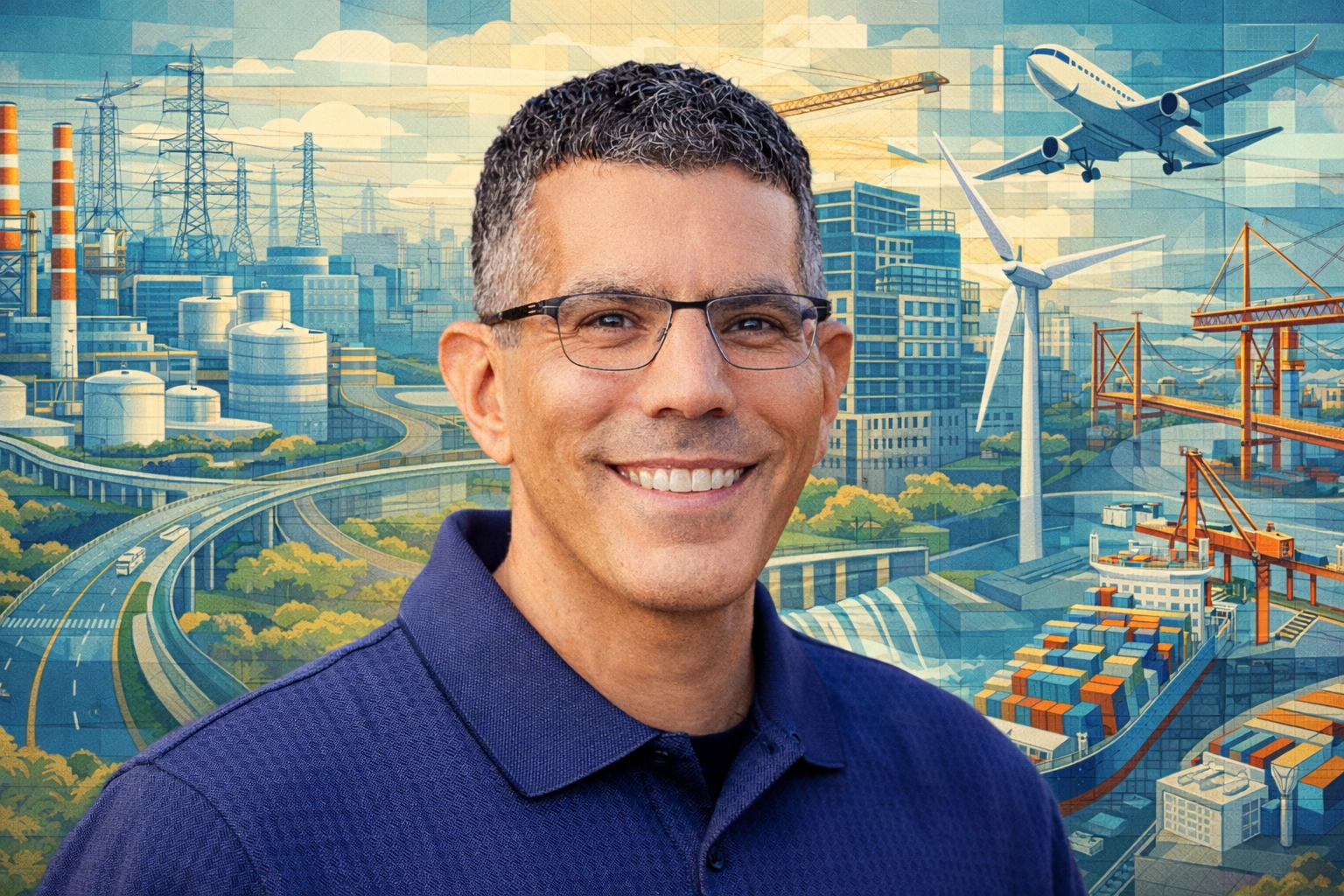
Through his career’s work, Mikhail Chester has developed a deep appreciation for a paradox of modern progress — the notion that even as technology advances, the world can feel increasingly complex and challenging, often evoking a sense of nostalgia for the perceived simplicity of the good old days.
In other words, change – even when it represents progress overall and over time – can introduce new kinds of complications.
Chester, the newly anointed Helmick Professor of Infrastructure Resilience in the School of Sustainable Engineering and the Built Environment, part of the Ira A. Fulton Schools of Engineering at Arizona State University, has built a career advancing the understanding of how today’s public infrastructure can better support communities by being designed and built to respond effectively to an array of disruptive natural events and other threats.
His expertise in bridging engineering, urban design, climate science and public policy has contributed to reshaping how we think about infrastructure planning in an era of frequent dramatic events and uncertainty, even after decades of scientific and technological progress.
“The Helmick Professorship recognizes faculty members whose work is not only intellectually rigorous, but deeply consequential for society,” says Professor Ram Pendyala, director of the School of Sustainable Engineering and the Built Environment. “Mikhail Chester exemplifies this ideal through his pioneering research on infrastructure resilience and sustainability.”
“He is an exceptional mentor who inspires and prepares students to think holistically about the long-term impacts of infrastructure decisions. Through his scholarship, teaching and mentorship, Dr. Chester is shaping both the future of infrastructure systems and the next generation of leaders who will design and steward them,” Pendyala says.
Potential solutions to the complex challenges of adequately fortifying modern urban infrastructure are detailed in the recent book “Infrastructure In The Anthropocene,” subtitled “The Changing Nature of Infrastructure In An Accelerating, Increasingly Uncertain And Increasingly Complex World,” coauthored by Chester and fellow Fulton Schools Professor Braden Allenby.
In an interview about the challenges confronting cities and communities, Chester talks about how his work and that of his colleagues is being guided by aspirations to more effectively fortify society’s infrastructural foundations.
Question: What does being named a Helmick Professorship make possible for your work?
Chester: These professorships are remarkably helpful. They provide stable and reliable resources for us to make investments in new strategic areas that have so far been overlooked. The Helmick Professorships and the resources that come along with them offer flexibility to explore, to innovate and to create new areas of work that might have significant impact into the future, opening new avenues of research that we haven’t yet been able to pursue.
Question: What challenges are you interested in tackling next, and how does the Helmick Professorship support your long-term vision?
Chester: These professorships are impactful because they allow us to take on challenges that don’t yet fit neatly into traditional funding categories, but that are increasingly urgent. They give us the freedom to explore new approaches to building more resilient infrastructure, especially in areas where the risks are emerging faster than the solutions.
Just as importantly, they remove the pressure to pursue only narrowly defined outcomes, which can limit innovation. That flexibility makes it possible to test new ideas, build cross-disciplinary partnerships and pursue work that could lead to transformative breakthroughs for communities facing growing environmental and infrastructure challenges.
Question: What specific vulnerabilities exist within today’s infrastructure and what will you do to address them?
Chester: The Helmick Professorship will give me the opportunity to examine how outdated design principles leave power, water and transportation systems vulnerable to extreme weather, cyberattacks and aging infrastructure. These risks are not isolated. A failure in one system can quickly cascade into others, compromising essential services that communities rely on in moments of crisis.
Specifically, we can scale our engineering simulations, test future scenarios and make our results available to broader infrastructure communities, run myriad future scenarios and determine the specific vulnerabilities that pose the greatest risk to communities. Following that, we can evaluate new resilience strategies and determine the approaches that are most effective at preventing system-wide breakdowns.
Question: Which communities will you engage with while doing the research?
Chester: I plan on conducting the research directly with local communities as well as infrastructure agencies. My work often involves communities as active partners as it’s critical to consider how they are impacted by disruptions. At the same time, infrastructure agencies are on the front lines of deploying novel solutions but are often constrained by limited resources or lack of cutting-edge data from scientists.
Question: How will the professorship support students?
Chester: The professorship will allow me to involve a broader range of students, including undergraduates and high school students, in addition to the usual graduate researchers. They will have unique opportunities to work with local infrastructure agencies and engineering firms on projects, gaining real-world experience while at the same time moving our research findings into practice.
Question: What will be the overall outcome of this professorship?
Chester: The goal is to help build a community of practice that can guide real infrastructure transitions. For me, that means connecting three things: generating new knowledge, preparing students to apply it and working directly with communities and agencies to put it into action. With the Helmick Professorship, I can advance all three at once, helping to move resilience research beyond theory and into systems that communities can actually use.