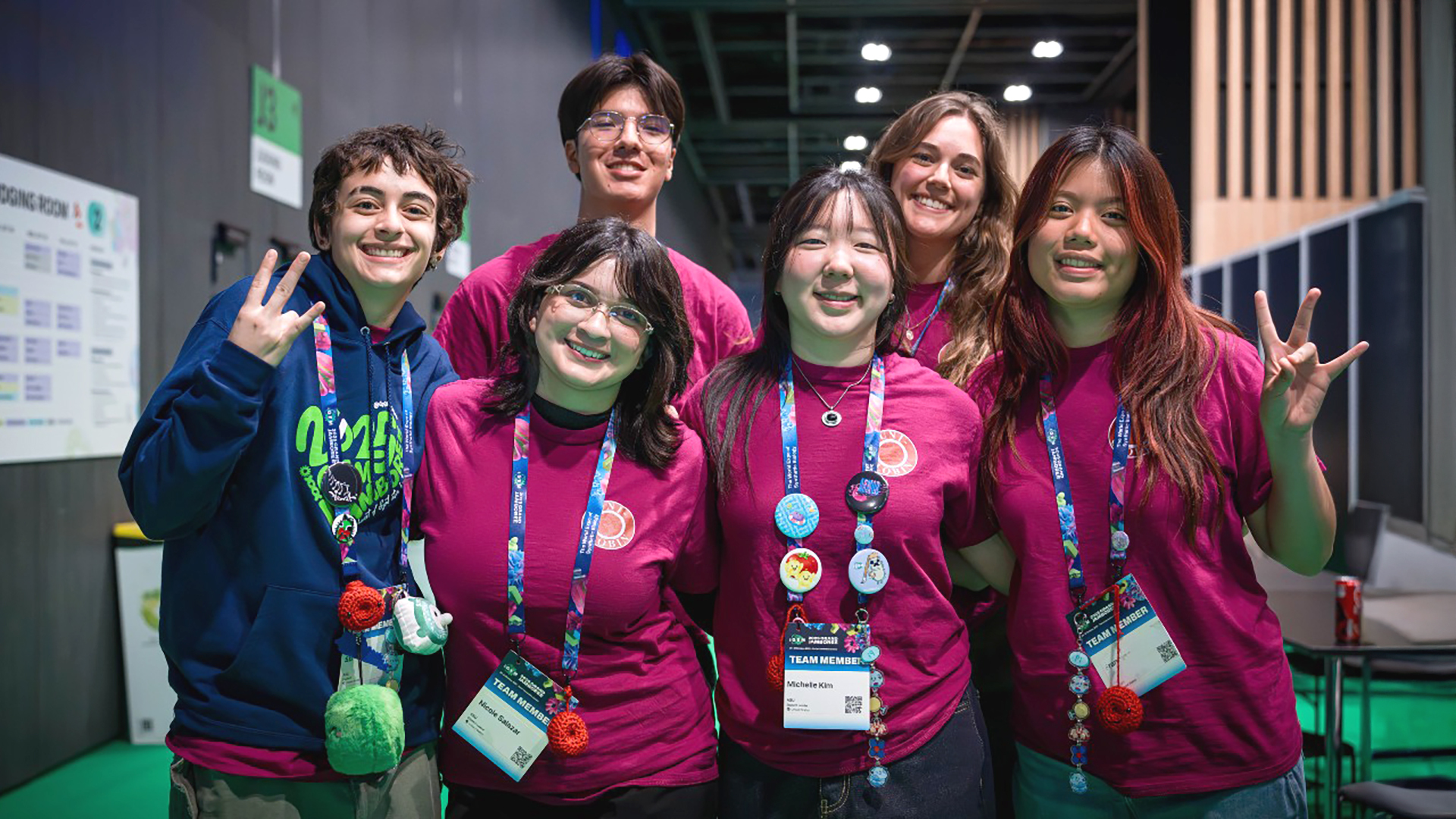
Arizona State University’s International Genetically Engineered Machine, or iGEM, team has once again gained global recognition, bringing home a gold medal at the 2025 iGEM Grand Jamboree in Paris, earning their fifth consecutive medal and third gold medal.
Their project, an emergency blood conversion kit that detects blood type-specific antibodies and removes them to be safe for transfusion, was inspired by the global need to ensure safer blood transfusions.
Nicole Salazar, a neuroscience senior in The College of Liberal Arts and Sciences at ASU and a member of the iGEM team, says the team’s kit could be instrumental for first responders to limit preventable deaths during natural disasters.
“It was an unforgettable experience to be alongside thousands of other students across the globe, all passionate about the same thing,” Salazar says.
This year’s team filed a provisional patent for new biotechnology developed during the competition, marking the first time an ASU iGEM project has advanced this far toward real-world application. Team members also submitted their first grant proposal to the Flinn Foundation, a prominent Arizona philanthropic organization supporting bioscience innovation, and began commercialization conversations with leaders of Skysong Innovations, ASU’s entrepreneurial hub that manages the business side of inventions arising from university activities.
Having grown familiar with the international podium, the ASU iGEM team is now looking to build technologies that could enter the marketplace.
A global stage for launching student success
Since its inception in 2003, the iGEM Grand Jamboree has grown into the world’s largest and most influential competition for collegiate synthetic biology by challenging students to tackle global challenges by engineering living systems to perform new tasks.
With more than 400 teams, the competition is widely regarded as a launching pad for biotech innovation. Their achievement places ASU alongside some of the world’s most elite institutions.
Ryan Crane, a mechanical engineering junior in the School for Engineering of Matter, Transport and Energy, part of the Ira A. Fulton Schools of Engineering at ASU, and a member of the iGEM team, says anyone with a passion for science can join. “No matter your major, interests or experience, everyone can get something out of iGEM.,” Crane says. “This year’s team included 22 students across disciplines who all utilized their unique skillsets and perspectives to contribute to a winning project.”

iGEM welcomes people from non-scientific backgrounds as well through initiatives such as iGEM startups and the iGEM community. Through these programs, individuals interested in starting a biotech business or creating science education materials have a space to make a real impact with their projects.
The team’s faculty mentor, Benjamin Bartelle, an assistant professor of biomedical engineering in the School of Biological and Health Systems Engineering, part of the Fulton Schools, says the team has cultivated an incredible pool of student talent.
“iGEM has become a global prestige event,” Bartelle says. “We have been incredibly fortunate that university leadership values what we do.”
Bioengineering solutions for blood accessibility
The team chose to tackle blood accessibility by building a constellation of sub-projects that explored a different side of the challenge, enabling the students to focus on tasks that let their strengths and passions shine.
“We perfected the approach of leveraging the breadth of interests our team members have,” Bartelle explains. “This year we had synthetic biology, immunology, hematology, biochemical assays, device design, weird biomaterials, community outreach and even a children’s book, all around the theme of blood accessibility. It was ridiculously ambitious, and not all of it worked, but everyone had their moment to shine.”
While much of iGEM focuses on demonstrating proof-of-concept technologies, the 2025 ASU project was developed enough to qualify for patent protection — a rare milestone for a student team working entirely on a volunteer basis.
“We filed a provisional patent to cover the whole project, but we expect to apply for two to three full patents by the end of next semester,” Bartelle says. “This is the first year the project had progressed to the point where a patent felt within reach.”
A provisional patent is the first formal step in the technology transfer process, preserving intellectual property while allowing the team to further develop, test and refine their innovations. While details of the protected technology will be disclosed later, the team’s novel biochemical assays, accessible diagnostic concepts and biomaterial innovations were highlighted by judges for their practicality and potential real-world impact.
ASU’s early patent work also strengthens its broader research ecosystem. Student-developed technologies that advance to the patent stage become candidates for future licensing, startup formation or deeper collaboration with the university’s innovation partners.
Although ASU does not currently have a formal synthetic biology degree program, iGEM has become a powerful center of gravity for students seeking hands-on experience in the field.
“There is a vast difference between someone with an interest in building with biology and a student who has picked up a pipette and gotten to work,” Bartelle says. “Those who come out of iGEM understand the struggle it takes to bring something real into the world.”
Supporting the synthetic biotech ecosystem
From lab work to mentorship, every component of ASU’s iGEM effort is volunteer-driven, allowing all financial resources to go directly toward supplies and travel. Bartelle hopes the team’s success, patent progress and increasing visibility will help secure continued support from faculty, graduate students and university leadership.
The team’s success over the last several years has sparked a budding synthetic biology ecosystem on campus. With new intellectual property secured and commercialization discussions underway, students can now explore the business and strategy side of biotechnology.
“Winning a gold medal was a great experience,” Salazar says, “but in future years, we want to work toward winning special prizes or grand prizes that highlight teams that excel beyond the gold medal and demonstrate excellence in specialties like entrepreneurship or education.”
As the team celebrates another gold medal and moves into a new phase of innovation, new opportunities continue to develop. An Khan Le, a biomedical engineering sophomore and iGEM team member, says she is proud to have accomplished something they once thought was impossible.
“We built a complete system from scratch, overcame challenges in every phase and crossed the finish line proudly with a gold medal,” Le says. “On top of that, we built real connections with one another. The science is exciting, but it’s the people and the growth that made this experience unforgettable.”