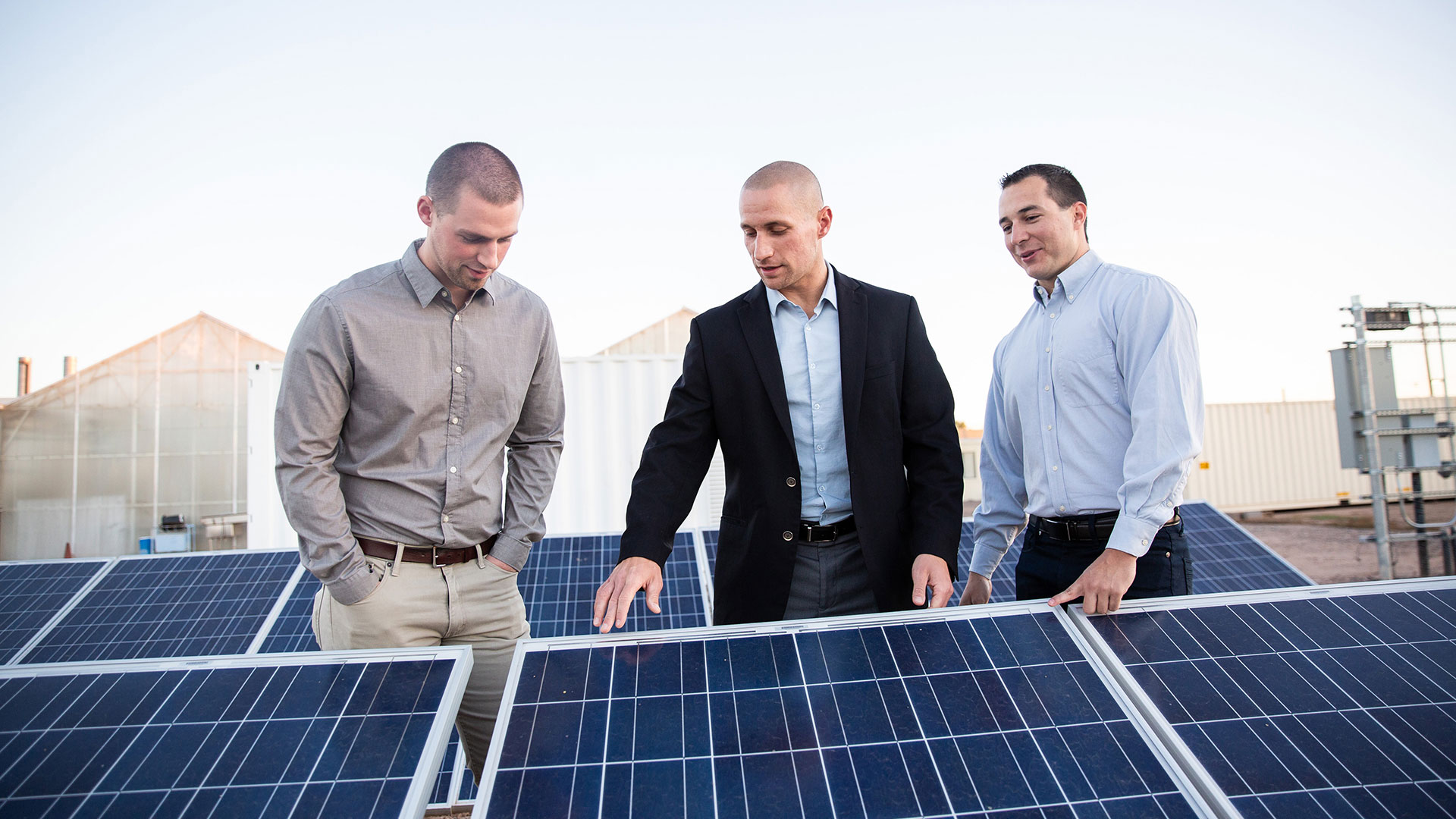
“The world needs every electron it can get to match the accelerated pace of economic development and electrification,” Nathan Johnson says. “In the United States, meeting that surge won’t come from a single technology, business model or policy.”
That insight from Johnson, a professor of engineering in The Polytechnic School, part of the Ira A. Fulton Schools of Engineering at Arizona State University, is both the organizing idea and the challenge facing the next decade. With data-center growth, the electrification of industry, the rise of artificial intelligence and onshoring of manufacturing, U.S. electricity demand is set to climb steeply in the next 10 years. This trend is advancing even faster in other countries.
The future will require practical, scalable solutions that knit together power generation, storage, smarter grids, workforce development and finance. That’s exactly the work ASU’s Laboratory for Energy And Power Solutions, or LEAPS, has been dedicated to for the last decade.
The LEAPS pitch is simple and urgent: translate university innovations into real infrastructure and the workforce at scale. The lab’s 10-year report shows $332 million mobilized, 161 megawatts of clean capacity-enabled and reliable power for over 100,000 people. The team also also trained thousands of workers across the energy sector and government.
Those headline numbers aren’t theory. They are evidence that the lab’s solutions and extension services model can deliver infrastructure, policy advice and trained people where it matters most.

Power for people, everywhere
The LEAPS project portfolio reads like a field guide to practical energy solutions. In Arizona, the broad partnership with the Hopi Tribe is an exemplar of locally led, culturally aware electrification that is supported by LEAPS technical assistance.
The Hopi face a persistent lack of access to energy. Even grid-connected homes experience a higher-than-normal number of outages due to dated infrastructure. LEAPS is working with the tribe and local partners to change that by bringing solar energy to homes and community spaces, strengthening power lines to make them more reliable, installing microgrids and training Hopi residents to maintain and manage these new systems. The project also builds lasting partnerships between the tribe, utilities, universities and local businesses to support energy independence and create long-term jobs for Hopi people.
The partnership encompasses several projects with technical and community-driven design. James Nelson, director of technology and innovation for LEAPS, notes that the work explicitly links energy access to job creation for a community hit hard by the closure of coal facilities.
“The project delivers cost-effective, reliable and locally managed power to Hopi households,” Nelson says. “By bringing electricity where no other options exist, we’re supporting energy sovereignty, economic opportunity and long-term resilience for the Hopi Tribe.”
Globally, LEAPS applies the same modular, partnership-driven playbook. In Fiji, the LEAPS team worked with the government to assess and prepare 75 sites for mini-grid power systems. Their work laid the foundation for about $40 million in upcoming construction projects and created new training opportunities to build a skilled clean energy workforce across the South Pacific.
In Madagascar, LEAPS helped produce an integrated energy plan that maps clean cooking and electrification pathways with prioritized investments that can reach universal access by 2030.
In Kenya, technical assistance and business coaching helped women-led energy firms scale, producing an estimated 14,000 new systems and a 48-fold multiplier of private follow-on capital. Across refugee relief, microgrid pilot projects, military resilience programs and municipal microgrid studies, LEAPS emphasizes deployable designs, local ownership models and measurable returns on capital.

Scalability isn’t an afterthought
What distinguishes LEAPS is a focus on scalable project development and a technical assistance model that amplifies finance.
“We’ve built a model where every dollar LEAPS spends attracts $10 to $50 more,” Johnson says. “That’s how you turn good ideas into large-scale impact.”
The lab’s teams do the engineering, shape business models, work with regulators and utilities, and then test systems — often using the lab’s Grid Modernization Proving Grounds and a mobile training trailer — so private and public partners can move quickly from pilot to procurement to construction.
This is how LEAPS turns pilots into programs: standardize the technical solution, reduce procurement risk, train operators and managers locally, and create financing structures that make projects investable.
One project paid for itself in just 18 months by using smart energy management to make better use of existing infrastructure instead of installing new capital assets.

ASU innovation and people power
LEAPS is also a campus-to-community engine. The lab has engaged over 300 students directly in projects and provided hands-on training and internships that translate classroom curiosity into career paths.
“Our microgrid proving grounds give people hands-on experience with real power assets,” Johnson says. “Most students come in with curiosity and passion. Our job is to pair that energy with opportunity and give them options to explore where they want to best fit in the energy economy.”
Alexander Mobley, associate director of technology evaluation and workforce development, explains that LEAPS runs professional courses that reach utility executives, U.S. Department of War personnel and frontline technicians, building the human capital needed to implement the technical solutions they design.
“Training isn’t an afterthought; it’s the foundation of our work,” Mobley says. “It equips people with the skills and leadership needed to deliver the energy solutions where they’re needed most.”
Why the next decade must look different
Johnson is blunt about the scale and urgency required to meet future energy needs.
“What the U.S. built in the last 100 years needs to be built again in the next 10. But we don’t have the people, materials or policies to do it the same way.”
The implication is not nostalgia for old infrastructure, but a call to do more with smarter designs, match demand to clean generation, tighten asset utilization and avoid the inefficiencies of overbuilding. That’s the pragmatic, all-of-the-above stance LEAPS brings to policymakers and communities.

A clear, practical mission
As LEAPS turns 10, its message is part technical, part civic: Clean, resilient energy is possible when universities turn ideas into solutions.
The LEAPS portfolio — Hopi electrification, multi-island mini-grids, national energy planning, refugee clinics with solar power, women-led business support, technology transfer, technical consulting and military resilience programs — shows how a single lab can move ideas into durable projects by combining engineering, finance, policy and training.
If the next decade is defined by an intensifying energy demand curve, then institutions that can translate innovation into infrastructure and training at scale will define success.
“We want to formalize our approach to solutions and extension services and expand it beyond energy into other sectors of the economy,” Johnson says. “I think that’s emblematic of ASU’s spirit in the New American University.”
For communities from the Hopi lands to remote Pacific islands, LEAPS is delivering energy and economic development in 20 countries, with more to come in the years ahead.


