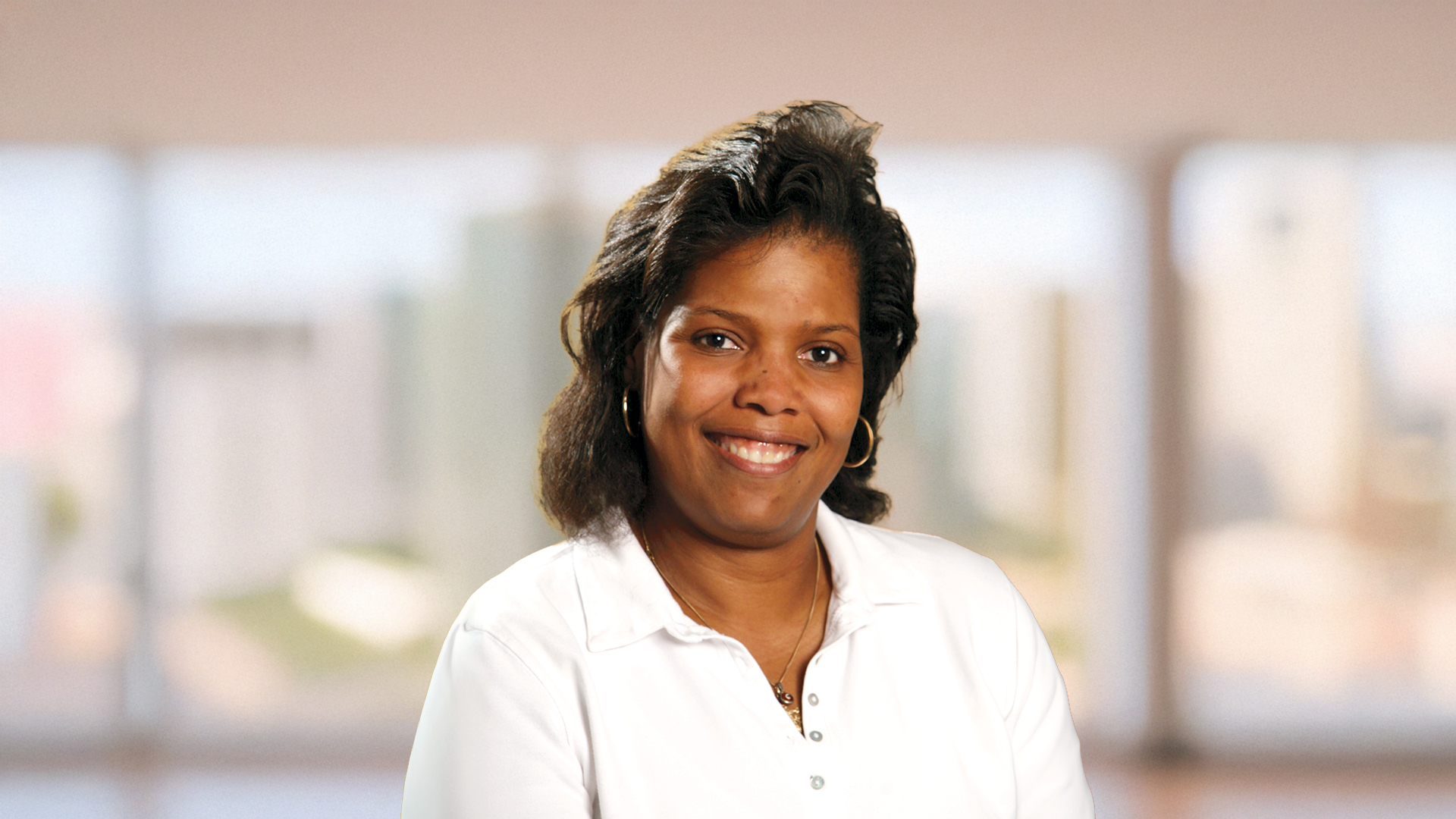
Especially in hot regions like Arizona, carbon dioxide, or CO2, levels inside your car are likely to be well above what’s considered healthy. And Jean Andino has the data to prove it.
Her team recently discovered a new patent-pending technology designed to keep drivers safe.
Andino’s leadership in this research, along with her broader contributions to environmental engineering, has led to her recently being designated a Board Certified Environmental Engineer via eminence in air pollution control by the American Academy of Environmental Engineers and Scientists, or AAEES.
Andino says the recognition is meaningful because it honors her years of hard work and success in the field of air pollution, a topic with particular prominence in urban areas like the one in the Bronx, New York, where she grew up.
“As both a Puerto Rican and an African American woman engineer, I always felt that my path was set to do something impactful,” she says. “My experiences have led me to be passionate about trying to create environmental impact, especially in communities that are historically underrepresented or under-resourced.”
Andino is an associate professor of chemical engineering in the School for Engineering of Matter, Transport and Energy, part of the Ira A. Fulton Schools of Engineering at Arizona State University. Her research group focuses on finding solutions to increasingly worsening air quality issues.
Over the years, Andino has grown to become a leading researcher in the field of air quality control. While most candidates undergo a rigorous process of exams and interviews to receive AAEES board certification, she earned the designation through the academy’s eminence pathway, a distinction reserved for established leaders whose careers and achievements cement their impact and substantial record or contributions to the field.
Recently, Andino has been focused on two critical and interconnected threads: researching solutions to air-quality challenges and helping communities adopt affordable practices for clean indoor air.
Controlling air quality issues
Andino is deputy director of the $25 million Southwest Urban Integrated Field Laboratory project, or SW-IFL, one of only four of its kind in the nation. While the four projects share similarities, the SW-IFL is distinct in two important ways.
“Our main focus is Arizona,” says Andino, explaining that the state is a vital area for research on extreme heat and its associated impacts, such as air quality, for the country and the world. “The conditions here are so extreme that it’s similar to the expected future scenario for some of these other areas.”
Andino adds that the SW-IFL has approximately 146 researchers with diverse technical backgrounds, including traditional atmospheric scientists, hydrologists, environmental engineers and even mechanical engineers.
What she finds most impressive isn’t the number of researchers, their expertise or the significant funding but the project’s collaboration among scientists and engineers from ASU, the University of Arizona and Northern Arizona University.
“If you think about the Flagstaff area versus the Phoenix area versus the Tucson area, the climates are very different in the summer, in particular,” Andino says. “The temperature difference leads to variability in air quality, vegetation and lots of other factors. So, having the three universities involved allows us to then make comparisons between the distinct climates, which significantly enhances the team’s overall modeling efforts and findings about how to deal with heat and the associated environmental impacts.”
Over the summer, her team within the SWIFL conducted an experiment that yielded a shocking discovery. Led by Andino, the team drove a car around the Phoenix metro area with CO2 monitors placed inside the car to track CO2 changes for two people. They also mounted a monitor outside the car to track CO2 changes in the air. Their goal was to study the correlation between temperature and CO2 levels in the car, and most importantly, whether the air conditioning systems of the car can keep CO2 at healthy levels in extreme heat.
The team observed that the CO2 levels in the car with two people quickly rose above the safe limit, established by prior research as 1,000 parts per million. Andino says that beyond this limit, the CO2 starts to impact human cognition and decision-making abilities.
“That observation led us to our invention disclosure, which ASU turned around within a week to file a patent application,” Andino says. “We have developed a patent-pending technology that would be useful for controlling carbon dioxide levels in, for example, a vehicle.”
Like this invention, Andino pursues spinoff projects with broadly similar objectives as the SW-IFL but with specific use cases, such as her $1.9 million research project funded by the U.S. Environmental Protection Agency, or EPA.
Teaching people how to create healthier indoor air environments
Working with Megan Jehn, an epidemiologist and professor in the ASU School of Human Evolution and Social Change, Andino has been educating middle school and high school teachers in Arizona on the fundamentals of indoor air quality in case of extreme events such as wildfires.
The team also develops monitoring tools and disseminates techniques for cleaning indoor air cost-efficiently. The team provides the teachers with a wide array of supplies, including air pollutant monitors, specialized cloths and portable air cleaning boxes.
“For under $100, the teachers can get the same type of air cleaning as that of a $500 or $600 commercial version of a portable air cleaner,” Andino says.
When reflecting on the experience, she told many transformational stories.
“I’ve had teachers who say, ‘My child has asthma. I put one of these boxes into their room, and their health improved so much,’” she says.
Andino says she is particularly proud of the impact her work has on kids.
“One of our teachers was so excited by this project that she got her students to think about the redesign of these boxes and how it could change their efficiency,” she says. “These happen to be seventh and eighth graders, and that enables them to think about engineering at such a young age. Inspiring them in that way has been very exciting.”
Shaping air quality research
Based on the impact of her work and in addition to her designation as a Board Certified Environmental Engineer, Andino has been elected to the President’s Advisory Committee on University Relations of the University Corporation for Atmospheric Research, or UCAR.
The organization is a consortium of 131 universities, including ASU, that runs the U.S. National Science Foundation National Center for Atmospheric Research. As part of the President’s Advisory Committee on University Relations, Andino will be involved in strengthening relationships between UCAR’s members.
“I look forward to working with other members of the committee to help improve Earth systems science,” she says. “This is a great opportunity to translate the research done by university partners into work that applies to local communities.”
Through her research and leadership positions in impactful engineering organizations, Andino has and continues to exceed her childhood dream of leading an impactful and fulfilling career.


