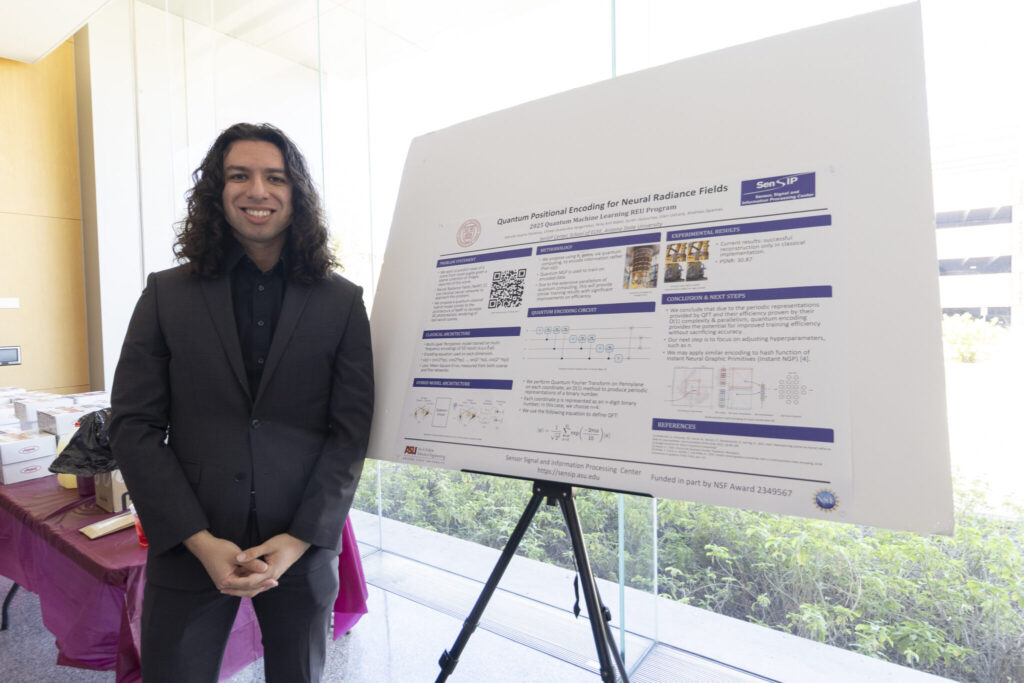
This summer, a select group of undergraduate students from across the country arrived at Arizona State University to immerse themselves in groundbreaking research at the intersection of quantum computing and machine learning.
As part of the Quantum Machine Learning Algorithm Design and Implementation program, students gained hands-on experience while working closely with ASU faculty mentors and graduate students. Funded by the National Science Foundation’s Research Experience for Undergraduates, or REU program, the initiative enabled students to explore new pathways in STEM fields, contributing to their future academic and professional goals.
Among the nine students selected from more than 630 applicants, each brought a unique perspective to the program.
Richard Zheng, an undergraduate mathematics major at Yale University, sees quantum computing as a powerful tool for industrial growth and is eyeing a career as a quantum computing expert. Sophia Wilhelm, a student in computer engineering and physics at the University of Illinois at Urbana-Champaign, used the summer to explore quantum computing’s potential to detect credit card fraud.
Carson Wolff, a computer science student from the Georgia Institute of Technology, has focused his research on using quantum computing for cancer detection. Ayman Neazi, a computer science student in ASU’s Ira A. Fulton Schools of Engineering, is conducting research on music synthesis using quantum neural networks.
These students’ projects were among others spotlighted at the recent Sensor, Signal and Information Processing, or SenSIP, center and industry consortium’s showcase held at the Biodesign Institute on the ASU Tempe campus. The students presented their research projects that provided a preview of how quantum algorithms are accelerating progress in machine learning and related high-tech fields.

The mentorship experience
SenSIP initiated work in quantum computing in 2023 with seed funds from the Quantum Collaborative through close interactions with Marisa Brazil and Torey Battelle, members of ASU’s Knowledge Enterprise team. As SenSIP’s activities have expanded, so has its mission to train the next generation of technology leaders.
Andreas Spanias, a professor in the School of Electrical, Computer and Energy Engineering, part of Fulton Schools, is SenSIP’s director and the principal investigator of its NSF REU project. He explains the significance of mentoring these students.
“We are focusing on training students how to do quantum machining learning simulations designed for applications across a variety of research areas where progress would be extremely beneficial,” Spanias says. “These are projects that could help us make advances in clean energy and health care and build up the nation’s industrial strength and economy, enabling us to better train our workforce and protect against all kinds of threats.”

Tanay Kamlesh Patel, a graduate research assistant in the SenSIP lab and coordinator of several REU projects, has seen firsthand how the program shapes students’ futures.
“I’m helping to guide the REU program’s logistics and the students’ research tasks on their respective quantum projects, helping them get familiar with the lab’s tools and introducing them to quantum algorithms and circuit design,” Patel says. “This will benefit them regardless of whether or not they pursue careers in this field.”
Glen Uehara, a senior scientist a General Dynamics and an electrical engineering doctoral student, provided foundational mentorship and tutorials on quantum simulations with IBM Qiskit and Amazon Braket to all REU participants. Other graduate students mentoring the visiting scholars included Niraj Babar, Tanay Patel, Prad Kadamvi and Kasra Dizaji.
The students also had a dedicated team of faculty mentors guiding them in their research, including Assistant Professor Christian Arenz, Professor Visar Berisha, Assistant Teaching Professor Gennaro De Luca, Associate Professor Suren Jayasuriya and Professor Spanias.
Student’s work this summer spanned a wide range of impactful research projects that contributed to advances in artificial intelligence, or AI, quantum computing and machine learning. Quantum computing’s ability to process vast amounts of data at incredible speeds has a variety of potential uses and is opening new avenues for health care applications, from diagnosing diseases faster to improving medical imaging and even developing personalized treatment plans.
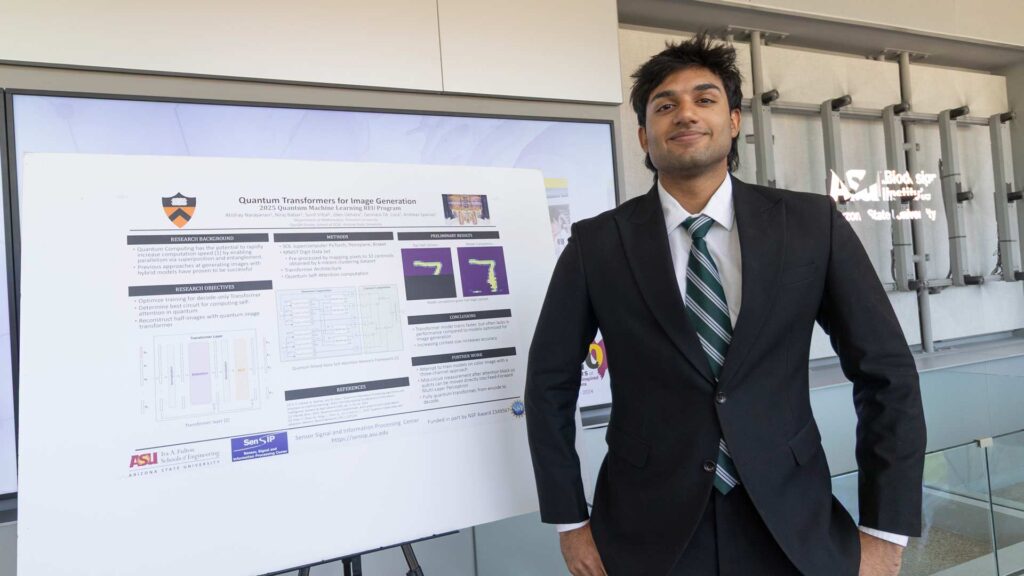
Nora Shaipi, a computer science student from Lafayette College, applied quantum machine learning to improve the diagnosis of dysarthria, a speech disorder associated with Parkinson’s disease. Another student, Atishay Narayanan, a math and computer science student from Princeton University, worked on using quantum transformers to generate medical imaging.
While some students focused on health-related applications, others explored entirely different challenges. Grace Kumble, an undergraduate at Carnegie Mellon, explored quantum machine learning to improve visualizations for three-dimensional reconstructions in engineering.
Through their varied projects, REU students are not only gaining skills but also contributing to next-generation multidisciplinary sensing applications in other fields such as biomedicine, defense and sustainability — all key areas for the future of technology and central to the SenSIP center’s mission.

The broader value of REU
Since its start only a few years ago, the SenSIP REU program’s progress has been attracting students who recognize its benefits. Spanias recalls when a previous REU program in 2017 drew only about 70 applicants nationwide, compared to this year’s REU quantum machine learning program attracting applications from close to 10 times as many students.
As the program has evolved, students from prestigious universities such as Princeton University, Yale University and Carnegie Mellon University have contributed new ideas and perspectives to enrich the research community. He believes it’s been gaining popularity because the REU program is about more than just technical skills.
“The students themselves benefit from presenting their work to industry representatives and getting feedback from them,” Spanias says. “One of our main missions is to teach students how to present their research results to different stakeholders, which is very beneficial not only to the students but to advancing SenSIP’s work.”
That focus on sharing knowledge doesn’t end with the students. The Research Experience for Teachers, or RET, program complements the REU experience by involving educators in research and helping them develop lesson plans to share their new knowledge with students. This collaboration extends the program’s impact, ensuring that the knowledge gained reaches a broader audience.

Jean Larson, an associate research professor at ASU with expertise in engineering education, notes that the REU program is opening students’ eyes to new research directions and helping them prepare for the demands of an evolving workforce.
“REU experiences are getting students excited about going to graduate school and doing advanced research, much of which can bolster national defense and serve the nation in so many other ways,” she says.
Larson foresees the program’s emphasis on interdisciplinary collaboration and real-world problem-solving paving the way for the next generation of researchers.
Looking ahead
As the program continues to grow, Spanias looks forward to seeing how the students’ research will impact the broader technological landscape.
“We are preparing students to tackle complex global challenges and drive the future of technology,” he says, stressing how students benefit from the experience of presenting their work to industry representatives.
“Having industry members participate in our events is proving very beneficial for the students and for the exposure of SenSIP’s work as well,” Spanias says.
Industry participants from American Express, General Dynamics, Lightsense, NXP, PSG, Poundra and Raytheon provided feedback to students during the REU poster session.
For students considering a career in quantum machine learning or related fields, the REU program offers invaluable experience, mentorship and the opportunity to contribute to the technologies that will shape tomorrow.
The SenSIP REU project is supported by the NSF award 2349567.