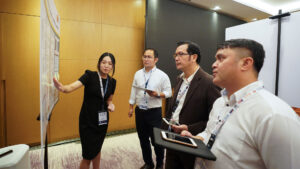
As nations around the world invest in the future of microelectronics, international collaboration has become essential. In July, Global Outreach and Extended Education, or GOEE, part of the Ira A. Fulton Schools of Engineering at Arizona State University, took a step toward expanding global engagement in the semiconductor industry by hosting faculty members from the Institut Teknologi Sepuluh Nopember, or ITS, a top university in Indonesia. The visit offered ITS faculty an opportunity to explore Arizona’s leadership in microelectronics education, research and workforce development.
The immersive two-week study tour, sponsored by the U.S. Consulate General in Surabaya, Indonesia, is part of a multiphase grant to foster sustainable partnerships between industry and academia. It aims to align the curricula taught in Indonesian classrooms with semiconductor industry needs. By collaborating with ASU, the program and others like it integrate global best practices into educational elements to enhance a country’s competitiveness and strengthen its partnership with the U.S. to build a more resilient semiconductor ecosystem.
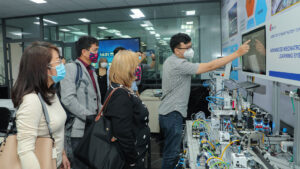
The visit provided a significant opportunity for the delegation to connect with ASU researchers, tour ASU facilities and learn about how Fulton Schools curricula and student-focused programs equip graduates for industry careers.
The study tour underscores GOEE’s mission to foster international partnerships across government, academia and industry to support mutual goals in research, innovation and workforce development. GOEE provides professional development opportunities, capacity-building initiatives and exchanges that leverage the Fulton Schools’ knowledge base and resources.
According to Jeffrey Goss, ASU associate vice provost for Southeast Asia programs, executive director of GOEE and an assistant dean of the Fulton Schools, institutions like ITS turn to ASU as a trusted partner. Goss says they recognize a shared commitment to advancing a strong semiconductor ecosystem through the integration of research, education and industry collaboration.
“This faculty study tour builds on the momentum of our first project activity, an integrated circuit design workshop held in Surabaya in May and marks a continuation of our shared efforts to co-develop curricula, strengthen faculty connections and prepare students for careers in microelectronics,” he says. “We’re excited to build on this foundation and grateful to the U.S. Consulate General in Surabaya for supporting this important collaboration.”
The exchange included multiple meetings with Fulton Schools leadership and faculty to explore ASU’s engineering research strategy, microelectronics workforce development activities and curricula designed to prepare students for careers in the semiconductor industry. The experience also facilitated guest lectures by ITS faculty members to share their institution’s history, research and goals for microelectronics development.
Astria Nur Irfansyah, an associate professor of electrical engineering and deputy director of international partnerships and global engagement at ITS, and Totok Mujiono, head of the Microelectronic and Embedded System Laboratory at ITS, provided a guest lecture to students and staff of the ASU Center for Semiconductor Microelectronics, or ACME, as part of the visit.
“On the research side, specifically for microelectronics, ITS research in mixed-signal circuit design and radio frequency systems intersects with the research at ASU,” Nur Irfansyah says. “ASU has strong expertise in these programs. Collaboration in the areas of training and joint research through research student exchange are possible activities achievable in the near future.”
In addition to discussions about research capabilities, working with GOEE enables visiting international delegations to learn how the university’s efforts contribute to local and national economic growth and security efforts.
“These visits offer a view into Arizona’s growing microelectronics ecosystem,” says Krishnendu Chakrabarty, Fulton Professor of Microelectronics and chief technology officer of the Southwest Advanced Prototyping Hub, or SWAP Hub. “Earlier this year, I had the opportunity to lead an integrated circuit design workshop at ITS. It’s exciting to now host them here and show how the SWAP Hub connects microelectronics prototyping and technology transition to the U.S. Department of Defense, industry and workforce development to drive innovation”
Nur Irfansyah points to the comprehensive tour of facilities as a highlight of the visit, offering valuable insight into advanced tools and capabilities unique to Arizona. The itinerary included site visits to ASU’s MacroTechnology Works, the Secure, Trusted and Assured Microelectronics Center, and the ASU NanoFab as well as to local industry collaborators Deca Technologies and NXP Semiconductors.
“Semiconductor device fabrication is lacking in Indonesia, and ITS is envisioning establishing a clean room facility to support research and training in semiconductor device and nanodevice fabrication, characterization and testing,” Nur Irfansyah says. “ASU has very strong facilities and serves as an excellent model that ITS can try to adopt, where there is a strong link between university and industry with regards to semiconductor-related academic programs and research projects.”

Moving forward, the ITS faculty members are eager to transfer the experience and the knowledge they’ve gained to complement existing efforts in Indonesia.
“ITS has strong emphasis on science and engineering, therefore sharing a lot of similar study programs and common areas of research interest with the Fulton Schools,” Nur Irfansyah says. “There is strong interest within Indonesia to develop talent and innovation in semiconductors, and ITS is eager to be part of this effort with its current programs and engineering courses.”
With a staffed representative office in Jakarta, ASU is actively partnering with local universities, government and industry to support Indonesian priorities in science, technology, engineering and math education, workforce development, and technology innovation. In 2024, ASU and Indonesia formalized a strategic partnership through the signing of a memorandum of understanding aimed at advancing education, research, workforce development and faculty and student exchanges.
A key objective of the collaboration is to strengthen Indonesia’s role in the global semiconductor supply chain and support its growing industry. By working with leading universities, such as ITS, ASU further strengthens relationships and allows knowledge sharing to drive innovation, enhance academic excellence and address global challenges through exchanges, joint research and interdisciplinary initiatives.