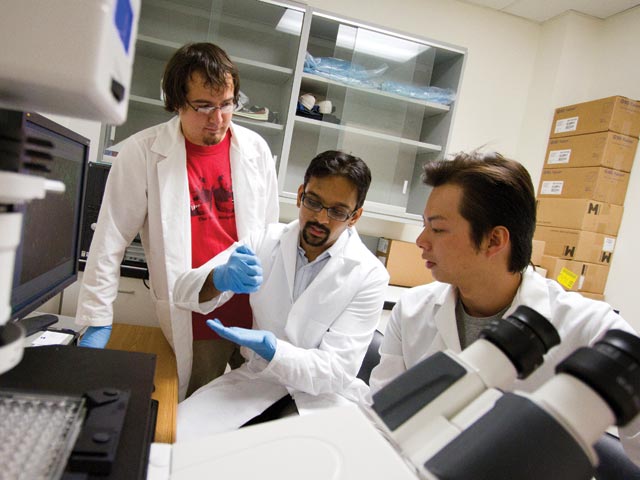
Our efforts range from understanding the causes behind Alzheimer’s disease and improving methods for predicting epileptic seizures to developing advanced biosensors, bioassays and lab-on-a-chip devices for clinical diagnostics. Additional areas of research exist in novel biological materials, neural engineering, drug-delivery systems, healthcare systems analysis and modeling, health monitoring devices and human rehabilitation technologies.
The American Heart Association selected three ASU bioengineers to fund research in cardiovascular health problems. Brent Vernon, associate professor, and David Frakes and Xiao Wang, assistant professors, are faculty members in the School of Biological and Health Systems Engineering.
Vernon and Frakes are conducting research in a partnership with the Barrow Neurological Institute at St. Joseph’s Hospital and Medical Center in Phoenix. They are working to develop new treatments for brain aneurysms. Brain aneurysms are major factors in the onset and progression of cardiovascular diseases, including heart disease and stroke.
Current treatment for aneurysms insert a metal coil into the forming pocket where blood collects and could potentially rupture. These coils form blood clots to prevent further flow to the area.
The technology that Vernon is working on will replace the coils with a hardening and degradable gel. Filling the aneurysm pocket with a gel would ensure against blood canals forming back into the pocket. The breaking down of the gel over time will ensure that no foreign materials will remain in the body.
A unique focus of Vernon’s is to release a protein with the gel to increase the growth of protective tissue around the aneurysm. The protein will promote the formation of protective tissues over the pocket, sealing it off from blood flow.
Frakes’ work involves experiments and simulations to prevent blood flow into new aneurysms and previously treated aneurysms. By studying the behavior of fluids in engineering terms, Frakes is seeking to predict and control fluid dynamics in relation to preventive clinical treatments.
Frakes’ work will help provide new and more accurate computation models for the simulation of brain aneurysms. Such models will be beneficial for devices being designed to treat aneurysms.
Wang is applying mathematics to biological problems. He is studying both cell differentiation and approaches to engineering gene networks to determine how they perform in treatments for cardiovascular ailments.
Wang will use mathematical modeling to provide precise looks at the fundamental principles guiding cell and gene network behavior. His models will help provide formulas for predicting the effectiveness of clinical treatment methods.

Pioneering brain computer interface
A partnership between Arizona State University and the Children’s Neuroscience Institute at Phoenix Children’s Hospital is working to advance the lives of people with brain and spinal diseases as well as people with disabilities. Stephen Helms Tillery, an assistant professor in the School of Biological and Health Systems Engineering, is leading the ASU team in the joint effort. Brain Computer Interface uses the brain waves of an individual to indirectly perform the activities that they would otherwise be incapable of doing. The technology can be applied to any number of conditions such as: severe brain disorders caused by stroke, severe cerebral palsy, amyotrophic lateral sclerosis (also known as ALS or “Lou Gehrig’s Disease”), spinal cord injury or similar disorders. By interfacing the patient’s brain waves with computers, the technology responds to the commands of the individual. Paralyzed patients could control a robotic arm, or type out their speech using their own brain signals to control a computer which enables them to send emails or simply communicate. Last year, the Arizona Biomedical Research Commission awarded a three-year grant to the combined efforts of ASU and the institute at Phoenix Children’s Hospital.ASU, Mayo develop imaging tracking system
With the help of ASU, researchers at Mayo Clinic in Scottsdale have developed a new imaging tracking system that provides a comprehensive view of a patient’s radiation exposure over time. Believed to be one of the first of its kind, the computerized tracking system can replace time-consuming manual tracking processes used in many medical centers. The DICOM Index Tracker (DIT) tracks all the information available in the images contained in a patient’s imaging studies (including dose, scanner utilization and other information) and compiles it into an accessible format. A team led by ASU’s Teresa Wu, associate professor, and Muhong Zhang, assistant professor, both in the School of Computing, Informatics, and Decision Systems Engineering, collaborated with the Mayo Clinic Department of Radiology to develop an enterprise tool for real-time radiation dose tracking. The system automatically retrieves information and can be used as a tool for quality assurance, skin dose map generation and equipment efficiency assessment, Wu says. In the past 20 years, there has been a migration to digital imaging for medical tests and, as a result, patient records contain a fairly accurate history of the radiation doses they have received. Yet, accessing dosage amounts from medical records had to be done manually and there has been a struggle to collect all of this information into a central repository. At the same time, the need to track dosages has become greater because of efforts within the medical community to lower radiation doses over time. DIT centralizes digital image information from tests such as mammography, CT scans, nuclear medicine and cardiac catheterization. The information then can be sorted by patient or procedure to assess the radiation dose and the number of treatments. Equally important, the system has alerting features built in to ensure dosages are within limit guidelines. American Heart Association grants advance cardiovascular health research
The American Heart Association selected three ASU bioengineers to fund research in cardiovascular health problems. Brent Vernon, associate professor, and David Frakes and Xiao Wang, assistant professors, are faculty members in the School of Biological and Health Systems Engineering.
Vernon and Frakes are conducting research in a partnership with the Barrow Neurological Institute at St. Joseph’s Hospital and Medical Center in Phoenix. They are working to develop new treatments for brain aneurysms. Brain aneurysms are major factors in the onset and progression of cardiovascular diseases, including heart disease and stroke.
Current treatment for aneurysms insert a metal coil into the forming pocket where blood collects and could potentially rupture. These coils form blood clots to prevent further flow to the area.
The technology that Vernon is working on will replace the coils with a hardening and degradable gel. Filling the aneurysm pocket with a gel would ensure against blood canals forming back into the pocket. The breaking down of the gel over time will ensure that no foreign materials will remain in the body.
A unique focus of Vernon’s is to release a protein with the gel to increase the growth of protective tissue around the aneurysm. The protein will promote the formation of protective tissues over the pocket, sealing it off from blood flow.
Frakes’ work involves experiments and simulations to prevent blood flow into new aneurysms and previously treated aneurysms. By studying the behavior of fluids in engineering terms, Frakes is seeking to predict and control fluid dynamics in relation to preventive clinical treatments.
Frakes’ work will help provide new and more accurate computation models for the simulation of brain aneurysms. Such models will be beneficial for devices being designed to treat aneurysms.
Wang is applying mathematics to biological problems. He is studying both cell differentiation and approaches to engineering gene networks to determine how they perform in treatments for cardiovascular ailments.
Wang will use mathematical modeling to provide precise looks at the fundamental principles guiding cell and gene network behavior. His models will help provide formulas for predicting the effectiveness of clinical treatment methods.


